
Galleria Oral & Maxillofacial Surgery in Roseville, CA specializes in rescuing failing dental implants — from single-tooth revisions to complex full-arch rescues that other practices call "untreatable."
Treatment options depend on individual bone density and medical history; please consult a qualified oral surgeon for a personalized recommendation.
Did you know that while dental implants boast a success rate between 95% and 98%, nearly one in ten patients may still face complications within a decade? If you're experiencing persistent discomfort, visible inflammation, or the devastating realization that your cosmetic result isn't what you were promised, you likely feel frustrated and perhaps a little fearful about what comes next. It's completely natural to worry about the complexity of "fixing" a procedure that was supposed to be permanent. You're looking for definitive answers and a path forward, not just another temporary patch.
We understand that a failed implant feels like a broken promise, but it doesn't have to be the end of your transformation. This guide explains how specialized dental implant revision surgery can rescue your smile, address the root cause of the initial failure, and restore your oral health with the clinical precision you deserve. We'll walk through the modern techniques used in Roseville and Sacramento to turn a failing implant into a stable, pain-free foundation. You'll gain a clear understanding of why failures happen, how our board-certified specialists correct them, and the transparent ways we make this essential rescue procedure accessible for our Northern California community.
Key Takeaways
- Understand the critical differences between early-stage failure and late-stage complications to identify the most effective path for your dental implant revision surgery.
- Discover why advanced 3D CBCT imaging is essential for creating a precise surgical blueprint, identifying hidden infections, and measuring bone volume accurately.
- Learn about specialized "Rescue" protocols that can often save a failing implant through professional decontamination, potentially avoiding the need for a full replacement.
- Identify the essential recovery milestones and why the "rest and digest" phase is vital for ensuring the long-term stability and health of your restored smile.
- See how choosing a board-certified surgical specialist in Northern California provides the mastery required for complex cases and same-day results.
What is Dental Implant Revision Surgery and Why Do Implants Fail?
Dental implant revision surgery is the specialized process of diagnosing, correcting, or replacing an implant that has failed to integrate properly, developed an infection, or produced an unsatisfactory functional or cosmetic result. Failures generally fall into two categories. Early-stage failures occur within the first few months, when the jawbone fails to bond with the titanium post — often due to surgical technique, poor initial placement, or premature loading. Late-stage complications develop years later, most commonly from peri-implantitis, a bacterial infection that silently erodes the bone supporting the implant.
Other culprits include untreated teeth grinding (bruxism), inadequate bone volume at the original placement, smoking, and uncontrolled systemic conditions like diabetes. Identifying the true root cause is the essential first step of any revision — replacing an implant without correcting the underlying problem simply sets the stage for a second failure. That's why revision cases belong in the hands of board-certified oral and maxillofacial surgeons who diagnose before they operate.
Advanced Diagnostics: The Blueprint for a Successful Revision
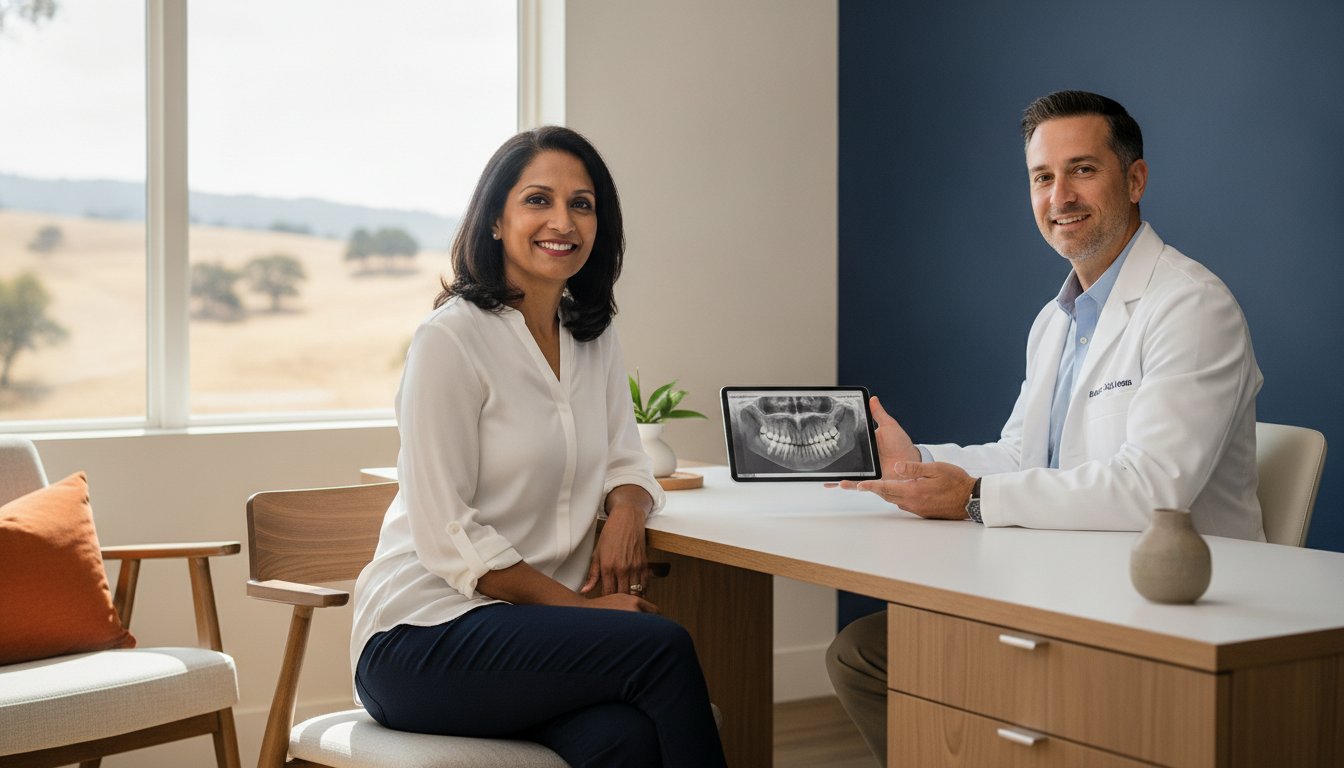
Every successful revision begins with a complete picture of what went wrong. We use Cone Beam Computed Tomography (CBCT) to capture a high-definition 3D image of your jaw, revealing hidden infections, precise bone volume measurements, and the exact position of the failing hardware relative to nerves and sinus cavities. This diagnostic blueprint tells us whether the implant can be rescued in place, whether it must be removed and the site regenerated, and exactly how a replacement should be angled for long-term stability.
The Role of Guided Surgery in Revisions
Once we have a 3D blueprint, we use computer-generated surgical guides to direct the revision. These guides act as a physical template during surgery, ensuring the new implant is placed in the "perfect" biological position. Precision placement does more than just ensure stability; it minimizes trauma to the surrounding tissue. This results in less swelling and a much faster healing process. We also coordinate the surgical placement with the final prosthetic design, ensuring your new smile looks as natural as it feels.
Revision Techniques: From Simple Fixes to Full-Arch Rescues
Many patients assume that dental implant revision surgery always involves a complete removal of the existing hardware. In reality, modern restorative techniques allow us to be much more targeted. If the titanium post remains securely fused to your jaw but the visible crown has chipped or the connector screw has loosened, we can often perform a simple hardware swap. This minimally invasive approach restores your smile's function and appearance without the need for a secondary healing phase.
When the issue is biological, such as the early stages of peri-implantitis, we employ a specialized "Rescue" protocol. This involves precise cleaning and decontamination of the implant surface. By removing the bacterial biofilm that causes bone loss, we can often stop the infection and save the original implant. However, if the post is loose or the bone loss is too extensive, a total replacement becomes necessary. This involves carefully removing the failed post, regenerating the site with advanced grafting materials, and eventually placing a new titanium or zirconia implant.
Complex full-arch cases, like All-on-4 dental implants, require an even higher level of surgical mastery. If one or two posts in a four-implant bridge fail, the entire restoration is at risk. Our specialists can often strategically replace the failing components or add supplemental implants to reinforce the bridge. This ensures you don't lose the investment you've already made in your smile while providing a stable, permanent result.
| Situation | Revision Approach | What It Involves |
|---|---|---|
| Chipped crown or loose screw | Hardware swap | Minimally invasive component replacement; no new healing phase |
| Early peri-implantitis | "Rescue" decontamination | Cleaning and decontamination of the implant surface to stop bone loss |
| Loose post or extensive bone loss | Removal and replacement | Removal, site regeneration with grafting, then a new implant |
| Failing full-arch bridge | Strategic reinforcement | Replacing failing posts or adding supplemental implants to save the bridge |
| Severe upper-jaw bone loss | Zygomatic implants | Anchoring in dense cheekbone to bypass damaged areas entirely |
Bone Grafting and the Foundation of Site Preservation
Bone grafting serves as the essential foundation for nearly every successful dental implant revision surgery. When an implant is removed due to infection, it often leaves behind a void in the jaw. We use site preservation techniques to rebuild this lost volume and prepare the area for a new fixture. This process requires patience; the bone typically needs several months to mature and strengthen before it can safely support a new load. This steady, methodical approach ensures that your second implant has the rock-solid foundation the first one lacked.
Zygomatic Implants: A Solution for Severe Bone Loss
For patients who have suffered extreme bone loss in the upper jaw, standard revisions might not be an option. In these challenging scenarios, we utilize zygomatic and pterygoid implants. These advanced fixtures anchor into the dense bone of the cheek or the back of the jaw, bypassing damaged areas entirely. They represent the gold standard for complex full-mouth rescues, offering a reliable solution for those who were previously told their cases were "untreatable." This technology allows us to restore a full smile even when the natural jawbone has been significantly compromised.
The Recovery Journey and Long-Term Success Strategies
Completing the surgical phase of your dental implant revision surgery is a major milestone, but the biological journey of healing is just beginning. The first 24 to 48 hours are focused on managing the body's natural inflammatory response. You should expect some swelling and mild discomfort around the surgical site; this is a sign that your immune system is hard at work. We prioritize a patient-centric approach to recovery, ensuring you have clear instructions and the necessary support to navigate these initial days with total confidence.
We often tell our patients to embrace a "rest and digest" philosophy during the first week. Physical activity must be limited because an elevated heart rate can increase swelling or disrupt the delicate clotting process. This period is vital for osseointegration, the process where your jawbone begins to grow around and bond with the new implant. Without this stability, even the most technically perfect surgery can't achieve long-term success. If you're ready to start your journey toward a restored smile, you can schedule your priority consultation with our Roseville team today.
Post-Surgical Care and Nutrition
Nutrition plays a starring role in how quickly you heal. For our revision patients in Roseville and Sacramento, we recommend a strict soft-food diet for at least the first ten days. Focus on high-protein, easy-to-consume options like Greek yogurt, lukewarm pureed soups, and protein shakes. Since we often utilize IV sedation for complex cases, you'll need a designated driver to take you home and a comfortable space prepared for rest. While complications are rare, you should contact us immediately if you experience a fever above 101 degrees, heavy bleeding that doesn't stop with pressure, or a sudden increase in swelling after the third day.
Preventing Future Failure: The Patient-Specialist Partnership
A revision isn't just a "redo"; it's a second chance that requires a new approach to maintenance. We work closely with you to address the specific habits that may have contributed to the initial failure. For example, if teeth grinding (bruxism) was the culprit, we may design a custom night guard to protect your investment. Professional cleanings are also mandatory, as standard dental tools can sometimes scratch the surface of an implant, creating a home for bacteria. The first twelve months following a revision surgery represent the most significant window for success, as this is when the biological bond between the bone and the new implant is fully solidified. Regular follow-up appointments allow us to monitor bone health and tissue stability, ensuring your new smile remains stable for a lifetime.
Choosing a Revision Specialist in Roseville, Rocklin, and Sacramento
When you're facing a second surgery, the margin for error is significantly smaller. You need more than just a general dentist; you need a team that specializes in the "impossible" cases. At Galleria Oral & Maxillofacial Surgery, we act as the specialist for specialists in Northern California. Our board-certified surgeons possess the technical mastery required for dental implant revision surgery, whether you need a single tooth repair or a complex full-arch rescue. We proudly serve patients across the region from our state-of-the-art surgical center in Roseville.
We understand the unique frustration and financial anxiety that comes with paying for a procedure twice. That's why we provide transparent, itemized treatment plans and flexible financing options, so you receive expert-level care without compromise. This transparency is a core part of our mission to restore not just your smile, but your peace of mind. We focus on providing same-day results whenever possible, helping you move past the trauma of a failed implant and into a state of informed confidence. Wondering how specialist-led care compares to corporate implant centers? See our guide to Galleria vs. ClearChoice.
Frequently Asked Questions
Is dental implant revision surgery painful?
You won't feel pain during the procedure because we utilize advanced IV sedation and local anesthetics to ensure your complete comfort. Post-operative discomfort is typically manageable with standard medication and usually subsides within a few days. Our team focuses on a gentle, patient-centric approach to alleviate anxiety and make the experience as stress-free as possible while we work to restore your oral health.
How much does dental implant revision surgery cost in Roseville?
The cost of dental implant revision surgery in Roseville depends on the complexity of the hardware removal and whether you need supplemental bone grafting to rebuild the site. Because every case is unique, we provide a detailed, transparent estimate after your 3D diagnostic scan, along with flexible financing options to manage the investment.
Can a failed dental implant be replaced immediately?
Immediate replacement is possible in some cases, but many patients require a healing period to rebuild the supporting bone first. If the failure was caused by a severe infection, we must clear the bacteria and perform a bone graft before placing a new post. This methodical approach ensures your second implant has the rock-solid foundation it needs for long-term stability and success.
What are the signs that my dental implant is failing and needs revision?
Common signs of failure include persistent pain around the site, visible swelling, or a feeling that the implant is slightly loose. You might also notice gum recession or a metallic taste if the hardware is exposed to the oral cavity. If you experience any of these symptoms, a professional evaluation is necessary to determine if you require dental implant revision surgery to save your smile.
Is dental implant revision surgery covered by insurance?
Many dental insurance plans provide partial coverage for the diagnostic and restorative portions of your revision, such as the new crown or infection treatment. While the surgical implant post itself is often considered a major procedure with limited coverage, our team helps you navigate your benefits to maximize your reimbursement. We also offer flexible payment plans to bridge any gaps in your insurance coverage.
How long is the recovery time after a revision procedure?
Most patients return to their normal daily routines within three to five days, though the internal healing of the bone takes several months. You'll need to follow a soft-food diet for about ten days to protect the surgical site from unnecessary pressure. The complete biological bonding process, known as osseointegration, typically requires three to six months before we can place your final, permanent restoration.
What is the success rate of dental implant revision surgery?
The success rate for revision surgery is high when performed by board-certified specialists who utilize 3D imaging and computer-guided technology. While the general success rate for initial implants is between 95% and 98%, revisions rely heavily on the quality of the remaining bone and the patient's systemic health. Our specialized protocols are designed to overcome previous biological failures and provide a reliable, long-lasting result.
Do I need a referral to see an oral surgeon for a revision?
You don't need a formal referral from a general dentist to schedule a consultation with our board-certified oral surgeons. While many local dentists send their most complex cases to our practice, we welcome patients who are seeking a second opinion or a higher level of surgical expertise. Booking directly with us allows you to start your rescue journey sooner and receive a definitive diagnosis from a specialist.