Galleria Oral & Maxillofacial Surgery in Roseville, CA provides board-certified, specialist-led implant care for molars and premolars — the workhorses of your bite — serving Placer County and the greater Sacramento region.
Candidacy, timelines, and costs vary by individual anatomy and health; the information below is general education, not medical advice. Please consult a qualified oral surgeon for a personalized evaluation.
Is it really a problem to leave a gap in your smile if it's tucked away at the very back? Many patients assume that since their molars are hidden, losing one is just a minor inconvenience. However, your back teeth are the structural anchors of your entire jaw. When they're gone, your bite collapses, your remaining teeth shift, and your jawbone begins to slowly deteriorate. Choosing dental implants for missing back teeth isn't just about aesthetics; it's a critical step in preserving your facial structure and your ability to enjoy your favorite foods without pain or hesitation.
We understand that the thought of oral surgery can feel overwhelming, especially when you're balancing concerns about recovery time and insurance coverage. You deserve a solution that feels as natural as your original teeth while fitting within your budget. In this guide, you'll discover how modern surgical techniques provide a durable, life-changing foundation for your oral health. We'll explore why replacing these hidden teeth prevents future complications, how transparent, itemized treatment plans remove the barrier of cost uncertainty, and what you can expect during the journey toward a fully restored, functional bite.
Key Takeaways
- Learn why missing molars cause remaining teeth to shift and how dental implants stop this destructive cycle.
- Discover why implants are the gold standard for restoration, offering a lifespan of 25 years or more compared to the limited durability of traditional bridges.
- Understand the specialized engineering required for back teeth, utilizing high-strength materials designed to handle your mouth's heaviest bite forces.
- Explore the modern patient journey, from advanced 3D CT surgical planning to comfortable sedation options that prioritize your peace of mind.
- See how board-certified surgical expertise and transparent, itemized pricing make life-changing dental restoration both accessible and reliable.
The Hidden Impact of Missing Molars and Premolars
Your molars do the heavy lifting of every meal — they handle the strongest forces in your mouth and keep your bite balanced from back to front. When one goes missing, the consequences unfold quietly. The tooth above or below the gap begins to over-erupt into the empty space, the neighbors tilt inward, and your chewing shifts to the other side of your mouth. Over months and years, this cascade wears down your front teeth (which were never designed for grinding), strains your jaw joint, and can trigger headaches and TMJ discomfort that seem unrelated to that "invisible" gap in the back.
Beneath the surface, the jawbone that anchored the missing molar begins to resorb almost immediately — losing measurable width and height within the first year. Because molars sit in the widest part of the jaw, this bone loss is significant, and it makes any future restoration progressively more complex. The earlier a back tooth is replaced with a dental implant, the simpler and more predictable the treatment tends to be.
Back Tooth Replacement Options: Why Implants Are the Gold Standard
There are three conventional ways to fill a molar gap: a removable partial denture, a tooth-supported bridge, or a dental implant. A partial denture restores appearance but only a fraction of chewing power, and it does nothing to stop bone loss. A bridge requires grinding down the healthy teeth on either side of the gap — permanently sacrificing sound enamel — and typically needs replacement within 5 to 10 years. In the back of the mouth, where forces are highest, bridges fail even faster.
An implant is the only option that replaces the root itself. It stands alone without touching neighboring teeth, halts bone resorption by transmitting chewing forces into the jaw, and is designed to last 25 years or more with proper care. For a single missing molar, a single tooth implant is the most conservative, longest-lasting choice — which is why oral surgeons consider it the gold standard for back tooth replacement.
The Engineering of a Molar Implant: Bite Force and Bone Density
Replacing a back tooth is a different engineering problem than replacing a front one. Molars absorb the heaviest bite forces in your mouth — often 150 to 200 pounds per square inch. That's why molar implants are typically wider in diameter than those used for front teeth, spreading force across more bone, and why the final crown is milled from high-strength materials like zirconia rather than the more delicate ceramics used in the aesthetic zone. Precise placement matters just as much: our surgeons plan every case on 3D CBCT imaging so the implant sits centered in the bone, aligned with the forces it will carry for decades.
Bone Grafting: When Is It Necessary for Back Teeth?
Bone density varies significantly between the upper and lower jaw. The lower jaw is typically denser, providing a solid foundation, while the upper jaw is softer and sits directly below the sinus cavities. When replacing upper molars, a sinus lift is often required to create enough room for the implant without penetrating the sinus membrane. This procedure involves gently lifting the sinus floor and placing bone material underneath, ensuring the implant has a thick, stable environment to anchor into. While this sounds complex, modern technology makes bone grafting a routine and comfortable part of the surgical journey. Galleria specializes in these complex cases, ensuring that even patients with significant bone loss can successfully receive implants for their back teeth. We use biocompatible materials that encourage your body to regrow its own bone, creating a permanent, rock-solid foundation for your new smile.
What to Expect: The Dental Implant Journey in Roseville
Starting the journey toward a restored bite is a structured, methodical process designed to move you from a state of concern to a state of total confidence. Because molar implants require such high levels of precision, we don't leave any detail to chance. Your experience is built on a foundation of advanced technology and patient-centric care. We guide you through every milestone, ensuring you feel informed and supported from your first scan to the moment you bite into your favorite food again.
Your First Consultation at Galleria
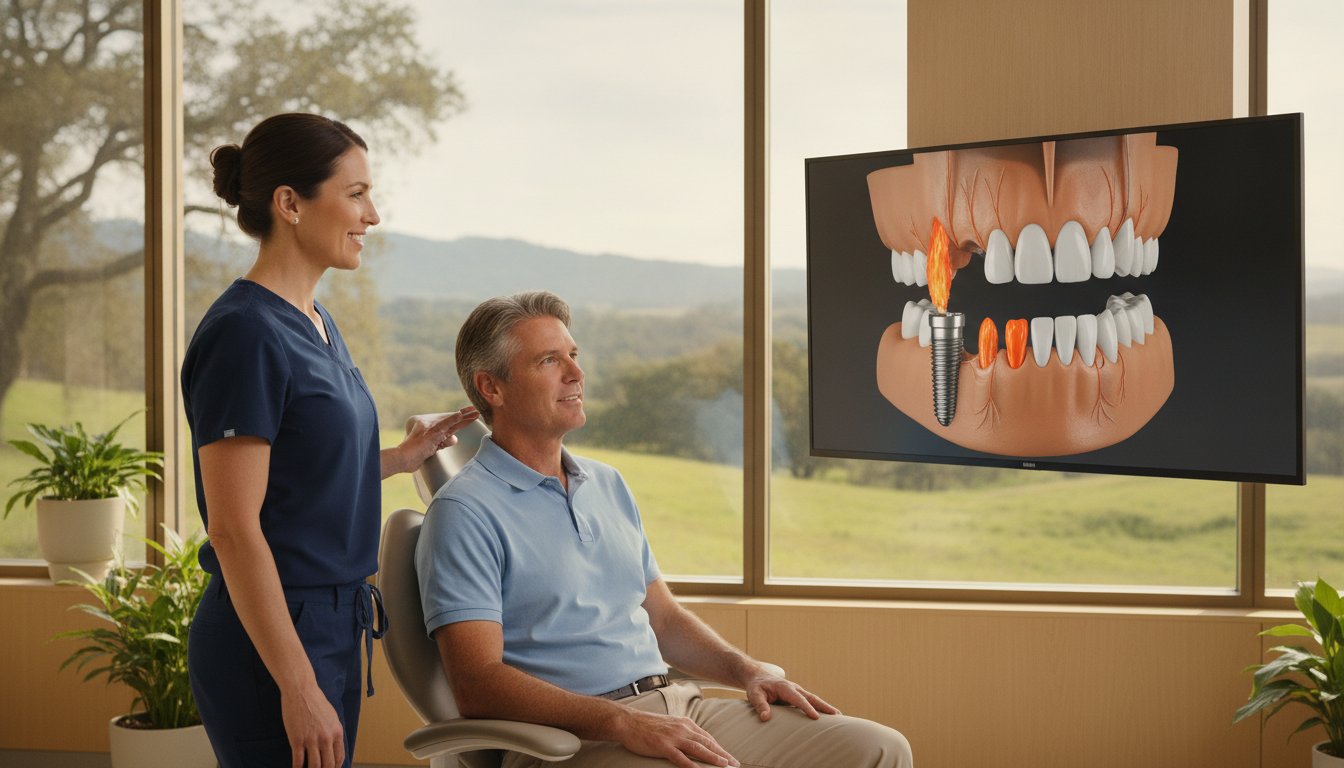
Your experience begins with a high-resolution 3D CT scan at our Roseville surgical center. This imaging is far more sophisticated than a traditional X-ray; it allows our board-certified surgeons to see the exact volume of your jawbone and the location of vital structures like nerves and sinuses. Using this data, we create a personalized surgical guide that dictates the perfect placement for your implant. During this visit, we also address the financial aspect of your care with a transparent, itemized treatment plan — every fee spelled out in writing before you commit. This transparency removes the "cost cloud" that often hangs over medical decisions.
Surgical day is centered entirely on your peace of mind. Unlike many general dental offices, we offer specialized IV sedation options administered by experts. You won't just be "numb"; you'll be in a state of deep relaxation where the procedure feels like it's over in minutes. Once the implant is placed, the biological healing phase begins. Over the next few months, your bone will fuse with the titanium post. Once healing is complete, we place your custom, permanent molar. This final crown is crafted from high-strength materials designed to match the shade and durability of your natural teeth. Our post-op care guide walks you through the recovery step by step.
Financing Your New Smile
Investments in your health shouldn't be a source of stress. We provide access to flexible payment plans tailored for California residents, making it easier to fit implant care into your monthly budget. Our team also works with your insurance provider to maximize your coverage and minimize out-of-pocket expenses. When considering the cost, it's helpful to look at the long-term return on investment. A traditional bridge often fails within a decade, requiring a second or third replacement over your lifetime. An implant is a one-time solution that preserves your jawbone and prevents the need for more expensive corrective work in the future. For a personalized ballpark, try our cost calculator.
Ready to reclaim your chewing power and protect your long-term oral health? Schedule your personalized 3D imaging session and take the first step toward a permanent solution.
Why Northern California Patients Trust Galleria
Choosing the right specialist for your restorative care is a decision that impacts your health for decades. While many general dentists offer basic tooth replacement, our practice is built around the specialized skill set of board-certified oral and maxillofacial surgeons. This level of expertise is particularly vital when placing implants for back teeth, where the proximity to sinus cavities and the need for structural stability require surgical precision. We don't just treat symptoms; we provide definitive solutions that stand the test of time. Our commitment to using the latest advancements in implantology allows us to offer same-day procedure options for many patients, minimizing your time in the chair and accelerating your return to full function.
Our surgical center in Roseville is designed to be more than just a dental office. From state-of-the-art imaging technology to comfort-focused care, every detail is optimized for advanced surgical treatment. This infrastructure, combined with an empathetic approach, helps alleviate the anxiety many patients feel when facing a major medical procedure.
Expert Care in Roseville, Sacramento, and Beyond
Our reach extends across the region, serving neighbors in El Dorado Hills, Elk Grove, Rocklin, Lincoln, Granite Bay, Folsom, and the greater Sacramento area. We believe that geographic location shouldn't be a barrier to elite surgical care. Our center is equipped to handle even the most complex cases, including patients who have been told elsewhere that they aren't candidates for implants due to bone loss. If you're feeling uncertain about a previous diagnosis, we encourage you to visit us for a second opinion. We take the time to listen to your concerns and provide a clear, transparent path forward that prioritizes your comfort and your budget.
Taking the Next Step Toward Full Function
Restoring your back teeth is one of the most significant investments you can make in your long-term wellness. By choosing dental implants for your missing back teeth, you're protecting your remaining smile, preserving your jawbone, and regaining the simple joy of eating whatever you like. You don't have to live with the discomfort of shifting teeth or the limitations of removable partials. Our transparent, itemized treatment plans ensure that you receive the highest level of surgical care at a price that reflects true value. It's time to move past the hesitation and step into a future of dental health and confidence.
Frequently Asked Questions
Is it really necessary to replace a missing back tooth if it does not show?
Yes, replacing a missing back tooth is essential for maintaining your jawbone structure and preventing adjacent teeth from tilting. Even if the gap isn't visible when you smile, your back teeth provide the necessary foundation for your bite. Without them, your front teeth endure excessive wear and your jawbone begins to resorb, which can eventually change your facial profile.
How much do dental implants for back teeth cost in California?
The investment varies based on your specific clinical needs and whether preliminary procedures like bone grafting are required. Since we prioritize transparency and value, every treatment plan is presented as a written, itemized document so you can see exactly what's included. We also provide flexible financing plans to help make this life-changing restoration manageable for your budget.
Does the dental implant procedure for molars hurt?
You shouldn't feel pain during the procedure because we utilize advanced IV sedation and local anesthetics to ensure your total comfort. Most patients describe the sensation as a mild pressure rather than sharp pain. After the procedure, any minor discomfort is usually well-managed with over-the-counter or prescribed medication, allowing you to return to your routine quickly.
How long is the recovery time for a back tooth implant?
Most patients return to work within one to two days after the initial placement. While the surgical site heals quickly, the biological process of osseointegration takes several months as the implant fuses with your jawbone. We'll monitor your progress closely during this time to ensure the foundation is rock-solid before placing your permanent, custom-made molar. See our recovery time guide for a day-by-day breakdown.
Can I get a dental implant if I have been missing my back tooth for years?
You can absolutely receive a dental implant even if your tooth has been missing for a long time. While years of absence often lead to bone loss, our surgeons specialize in regenerative techniques to rebuild the necessary support. We'll use 3D imaging to assess your current bone volume and determine if a graft is needed to create a stable foundation.
What happens if I do not have enough bone for a molar implant?
If you lack sufficient bone density, we can perform a bone graft or a sinus lift to restore the necessary volume. These routine procedures create a stable environment for the implant to anchor securely. Our board-certified surgeons are experts in these complex cases, ensuring that even significant bone loss doesn't prevent you from achieving a functional bite.
Will my insurance cover dental implants for missing back teeth?
Many dental insurance plans now offer partial coverage for implant-related procedures, though the amount depends on your specific policy. Our administrative team works directly with your provider to maximize your available benefits and clarify your out-of-pocket costs. We're committed to helping you navigate these logistics so you can focus on your health and recovery.
Why should I choose a board-certified surgeon for my back teeth?
Choosing a board-certified surgeon ensures you're receiving care from a specialist with the highest level of training and technical mastery. Back teeth often involve complex anatomy like sinus cavities and dense bone, requiring a surgeon who can manage these variables safely. This expertise translates to higher success rates, better comfort, and more predictable long-term outcomes for your smile.