Avoiding an additional procedure is a reasonable preference. It should not become the only goal of implant treatment. At Galleria OMS in Roseville, the question is whether existing bone can support implants in positions that also allow safe, useful and maintainable replacement teeth.
General education from Galleria OMS. Your examination, health history and treatment plan determine appropriate care. Follow your treating clinician’s instructions; individual results vary.
Key takeaways
- Many implant sites do not need grafting, but suitability is site-specific.
- “No graft” does not mean an implant needs no bone support.
- Shorter, narrower or angled implants address different anatomical situations.
- A graft may still be the more appropriate way to achieve the intended restoration.
Start with the planned tooth position
An implant should do more than fit somewhere in the jaw. It must support a restoration with an appropriate bite, appearance and cleaning access. A location with available bone may still be unsuitable if it leads to an impractical final tooth or bridge.
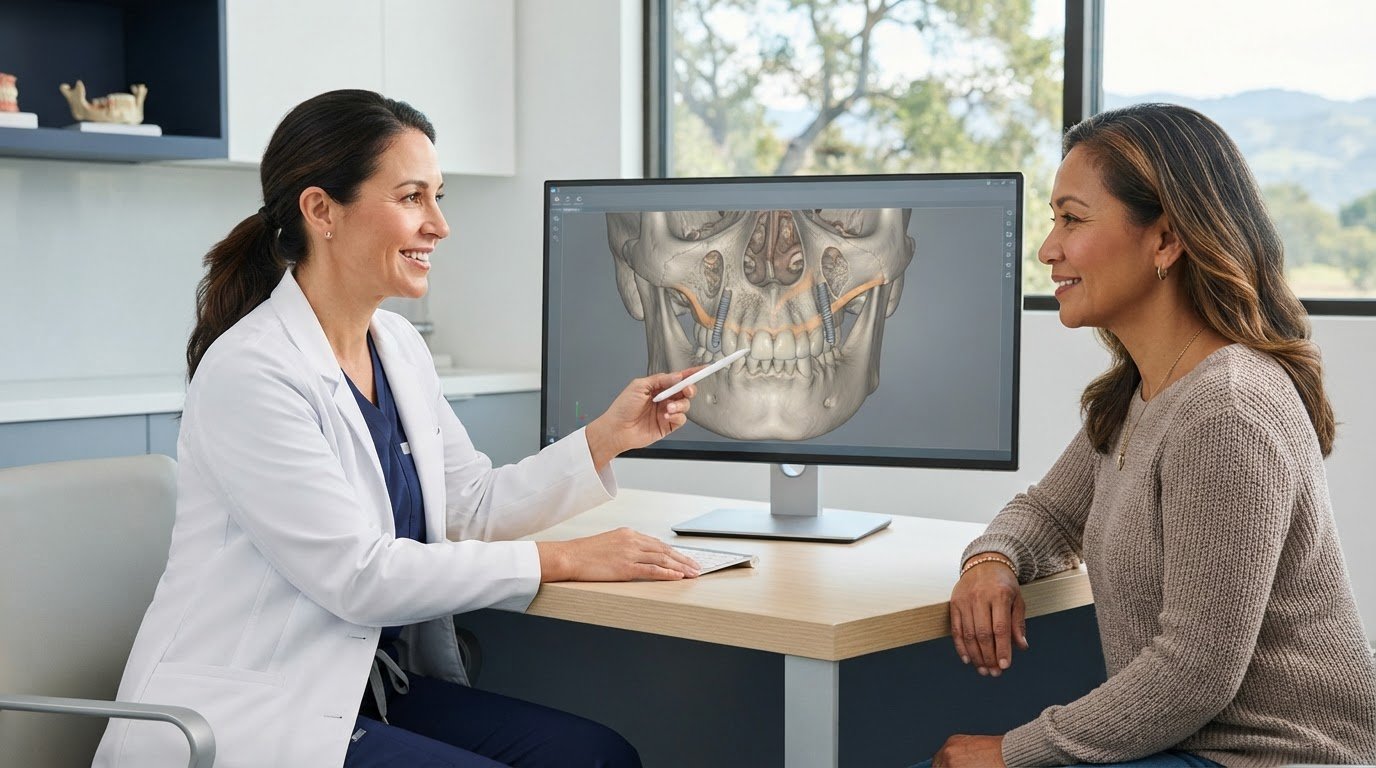
Examination and appropriate imaging help assess bone dimensions, nearby nerves or sinuses and the relationship to the proposed teeth. There is no single bone measurement that establishes candidacy for every implant design and every site.
| Situation or option | What it involves | What to clarify |
|---|---|---|
| Conventional placement without grafting | Uses adequate bone at the intended site | Can the implant position support the planned restoration? |
| Selected short implants | Work within reduced vertical space in suitable sites | Are support and expected bite forces appropriate? |
| Selected narrow implants | Address particular width or spacing constraints | Is this diameter appropriate for the tooth and loading needs? |
| Planned angled placement | Uses suitable existing bone in a different direction | How will the implants and restoration work together? |
| Specialized upper-jaw anchorage | Uses alternative bone in selected complex cases | What expertise, risks and follow-up does the approach require? |
| Bone grafting | Rebuilds a deficient area for the intended plan | What benefit does preparation offer compared with alternatives? |
Understand the limits of smaller implants
Changing length or diameter does not automatically solve every deficiency. The clinician also considers bone quality, restoration dimensions and chewing forces. Narrow implants and mini implants are not blanket substitutes for conventional implants or grafting.
Ask why the proposed design suits your situation and what tradeoffs it introduces. A shorter surgical sequence is useful only if the resulting plan is clinically appropriate.
Full-arch planning creates different possibilities
Several implants supporting a full-arch restoration may be distributed to use available bone. Selected angled configurations can be part of that strategy, but a familiar treatment name does not guarantee grafting can be avoided.
For some severely deficient upper jaws, specialized implant approaches may enter the discussion. These have distinct risks and expertise requirements. They are not routine alternatives for a single missing tooth or a guarantee of immediate fixed teeth.
When grafting may still make sense
Bone grafting may help create support at a position important to the final restoration. It can add a procedure, healing time and cost, but avoiding those steps is not automatically safer or more predictable.
Ask which problem the graft addresses, what alternatives exist and how success will be assessed. If an alternative is offered, compare the whole plan—including restoration design and maintenance—not just the number of surgical appointments.
Bring prior scans and recommendations
If one clinician recommended grafting and another proposed a graft-free option, the plans may involve different implant positions or restorations. Ask each to explain those differences. Previous imaging can help, although new imaging may be required.
A second assessment may identify another pathway or confirm that preparation is needed. If neither implant approach is appropriate, a non-implant replacement deserves discussion. The purpose of consultation is an informed choice, not a promise that every preference can be met.
Frequently asked questions
Does no graft mean same-day teeth?
No. Grafting, implant placement and loading are separate decisions. Stability and other clinical findings determine whether early temporary teeth are suitable.
Are graft-free implants less expensive?
Not necessarily. Specialized techniques or different restorations can change the overall cost. Compare complete individualized estimates.
Can a scan guarantee I will not need a graft?
No. Imaging is important, but examination and sometimes surgical findings affect the final plan. Ask about contingencies before treatment.
Plan your next step with Galleria OMS
Request a consultation with our Roseville team or call 916-783-2110. Galleria Oral & Maxillofacial Surgery is located at 911 Reserve Drive, Suite 150, Roseville, CA 95678. Bring available records and your questions so we can discuss surgical options and coordination with your restorative dentist.