
Replacing a missing front tooth presents two related problems: creating a stable foundation and planning a tooth that sits comfortably among the teeth and gums you can see when you smile. The implant is only one part of that work. Your temporary appearance, healing time, crown design, and long-term hygiene all deserve attention before a procedure is scheduled.
Galleria Oral & Maxillofacial Surgery sees patients at its Roseville office, including people traveling from Sacramento, Rocklin, Lincoln, Loomis, El Dorado Hills, Elk Grove, and surrounding communities. This overview can help you prepare questions; an examination is needed to know which replacement is appropriate for your tooth and tissues.
Key Takeaways
- A front-tooth implant plan should consider the visible crown and gumline as well as the implant's position.
- Extraction, grafting, implant placement, healing, and final crown delivery may occur at different visits.
- Same-day provisional teeth are conditional; ask how the visible space would be managed if they are not appropriate.
- Compare an implant crown with a bridge or removable interim option based on adjacent teeth, tissue health, and maintenance.
Start with the tooth that is there—or the space it left
If a front tooth is damaged but still present, your first conversation should address whether it can be retained and why extraction is or is not recommended. If it is already missing, the clinician examines the remaining bone, gums, bite, and neighboring teeth. A medical and dental history matters as well: healing conditions, medications, and gum disease may affect the sequence of care. Imaging helps locate adjacent roots and assess the intended implant site.
A front tooth is part of a visible framework. A custom crown may be shaped and shaded to relate to neighboring teeth, but the appearance of the gumline depends on the existing tissue and how it heals. Ask the team to identify what can be planned in advance and what remains uncertain. An exact match in shade, contour, or gum height cannot be guaranteed.
Understand the stages of the procedure
Site preparation and implant placement
If the tooth needs extraction, the surgeon evaluates whether implant placement can occur at the same appointment or whether a staged approach is more suitable. Bone grafting or other site preparation may be discussed if supporting tissue is insufficient; it is not automatic. An implant post is positioned in the jawbone to support a future crown. The exact timing depends on anatomy, the condition of the site, and the treatment plan.
Healing and a visible interim solution
After placement, bone must heal around the implant. This biological integration takes time and varies among individuals. Your team may suggest a temporary tooth to address the visible gap while healing progresses. It might be supported in a way that avoids pressure on the new implant, or a provisional crown may be considered if the clinical conditions allow. Same-day provisional placement is not assured: implant stability, bite forces, and site conditions influence eligibility.
Ask a concrete question: “If a temporary crown cannot be attached to the implant that day, what would I wear instead?” Also ask what foods and habits could disturb the area and who will check healing. A temporary restoration should not be mistaken for the finished crown. If a provisional is placed, your clinician may still require a modified diet and later restorative appointments.
Final crown and continued review
Once the site has been assessed for readiness, an abutment connects the implant to its custom crown. The restorative clinician considers shape, color, contact with adjacent teeth, bite, and access for cleaning. Ask who designs and places the final crown and how they communicate with the implant surgeon. After delivery, continue routine professional evaluations and daily cleaning; the crown and surrounding tissues may need future care or repair.
How does an implant compare with other front-tooth choices?
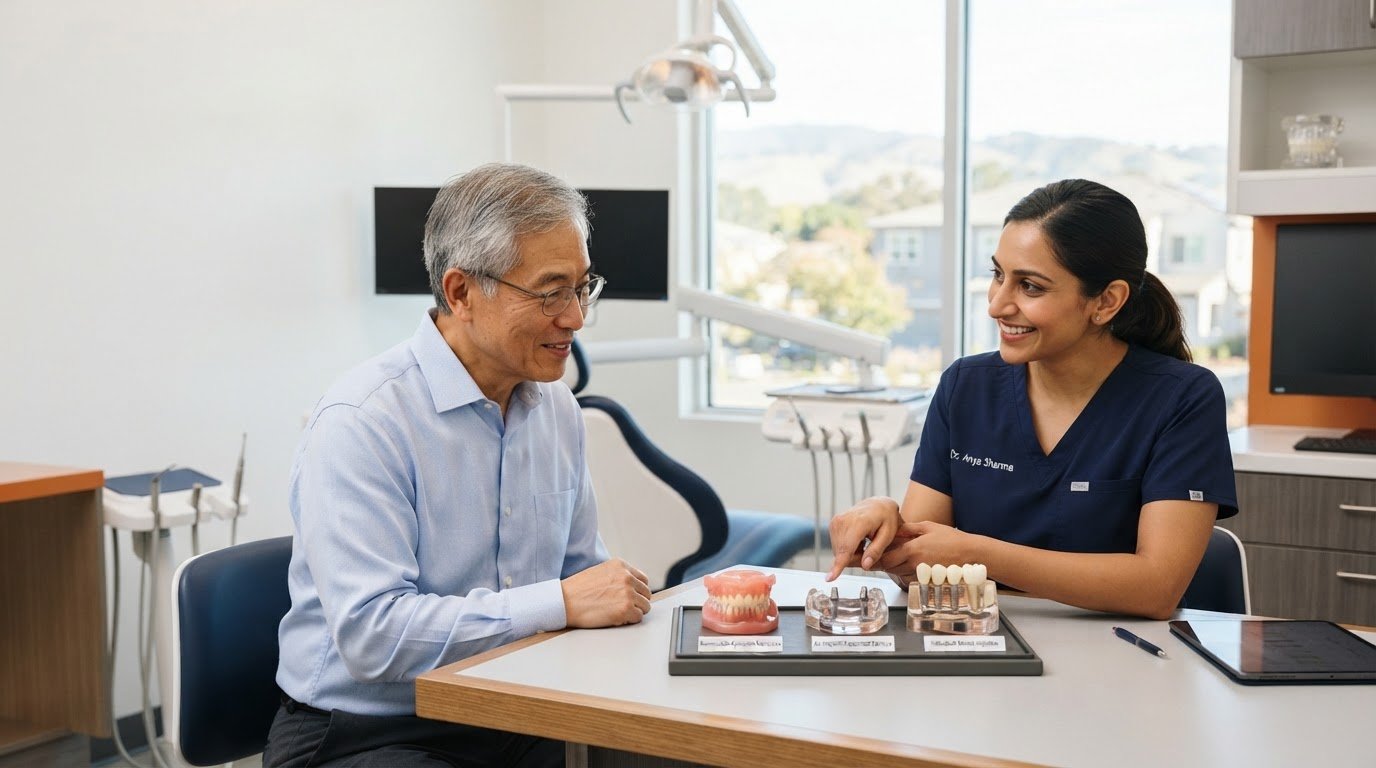
A bridge may be reasonable for some patients, particularly when neighboring teeth already need restorative work; an interim removable tooth can address the appearance of a gap while a longer-term decision is made. The table compares how options function rather than ranking them. Your dentist and surgeon can explain which ones fit your findings.
| Option | How it is supported | What to ask |
|---|---|---|
| Implant crown | Crown attached to an implant in the jaw. | Is the bone and tissue suitable? How are healing and hygiene managed? |
| Conventional bridge | Replacement supported by prepared neighboring teeth. | How healthy are those teeth, and how will I clean underneath? |
| Bonded bridge | Replacement bonded to an adjacent tooth or teeth. | Is the bite appropriate, and what are the limits of this design? |
| Removable interim tooth | Appliance worn and removed as instructed. | How will it fit, be cleaned, and avoid pressure on a healing site? |
Unlike a conventional bridge, an implant crown does not use neighboring teeth as its primary supports. That distinction alone does not make it best for every patient. A bridge has its own maintenance needs, while an implant requires adequate site conditions and healing. If you want a broader discussion of single-tooth replacement, read our single-tooth implant guide.
Prepare for the consultation and recovery
Ask about the visible gap before it becomes urgent
Bring recent dental images if available, a medication list, and photographs of your smile if they help explain your goals. Ask who decides whether extraction and implant placement can be combined, whether additional preparation could be needed, what temporary options are feasible, and who will make the final crown. A written plan should distinguish planned steps from contingencies and explain the expected check-ins between surgery and restoration.
Follow the instructions for your actual procedure
Some soreness and swelling may follow implant surgery, but experiences vary. Ask about anesthesia options, prescribed medications, oral hygiene around the site, food restrictions, and signs that warrant a call. Do not assume a front provisional can withstand normal biting. Follow your treating team's specific instructions rather than a generic timeline, and contact them if pain worsens, bleeding persists, or you are concerned about the temporary tooth.
Healing and crown delivery may span months, especially when extraction or grafting adds stages. The appearance of a temporary tooth does not mean integration is finished. If you are trying to plan work, travel, or an event, ask for an estimated sequence with contingencies rather than a guaranteed completion date. Our implant recovery overview provides additional general context.
Frequently Asked Questions
Can a front tooth be extracted and replaced with an implant on the same day?
Sometimes, but an examination and imaging are needed to assess the tooth, bone, and site conditions. Same-day implant placement and same-day attachment of a provisional crown are separate decisions. Either might not be appropriate for your case.
Will I have to go without a visible tooth while healing?
Not necessarily. A removable or other temporary option may be considered even when a provisional cannot be attached to the implant. Ask what is suitable for your site, how it is retained, and what restrictions protect healing.
How long until the final front crown is placed?
There is no universal date. Preparation, implant placement, integration checks, and crown fabrication may require separate visits. Your surgeon and restorative clinician can estimate the sequence after assessing the site and update it as healing progresses.
Will the implant tooth exactly match my natural teeth?
A custom crown can be planned with neighboring tooth color, shape, and gum contours in mind, but healing and individual anatomy affect the result. Ask what cosmetic limitations the team sees in your case; an exact match cannot be promised.
What if there is too little bone for an implant?
The clinician may discuss grafting, a staged approach, or a different replacement such as a bridge, depending on the findings. Ask how each option affects timing, maintenance, and neighboring teeth. Candidacy cannot be determined from a photo or article alone.
Plan the replacement, not just the surgery
For a front tooth, a good consultation covers the surgical site, what you may wear while healing, the final crown, and who handles follow-up. Contact Galleria Oral & Maxillofacial Surgery in Roseville to ask about an evaluation and how your surgical and restorative care can be coordinated.
This is general educational information, not an individual diagnosis or treatment recommendation. Your own clinician must assess your oral health, imaging, and medical history to advise on options, risks, timing, and aftercare.