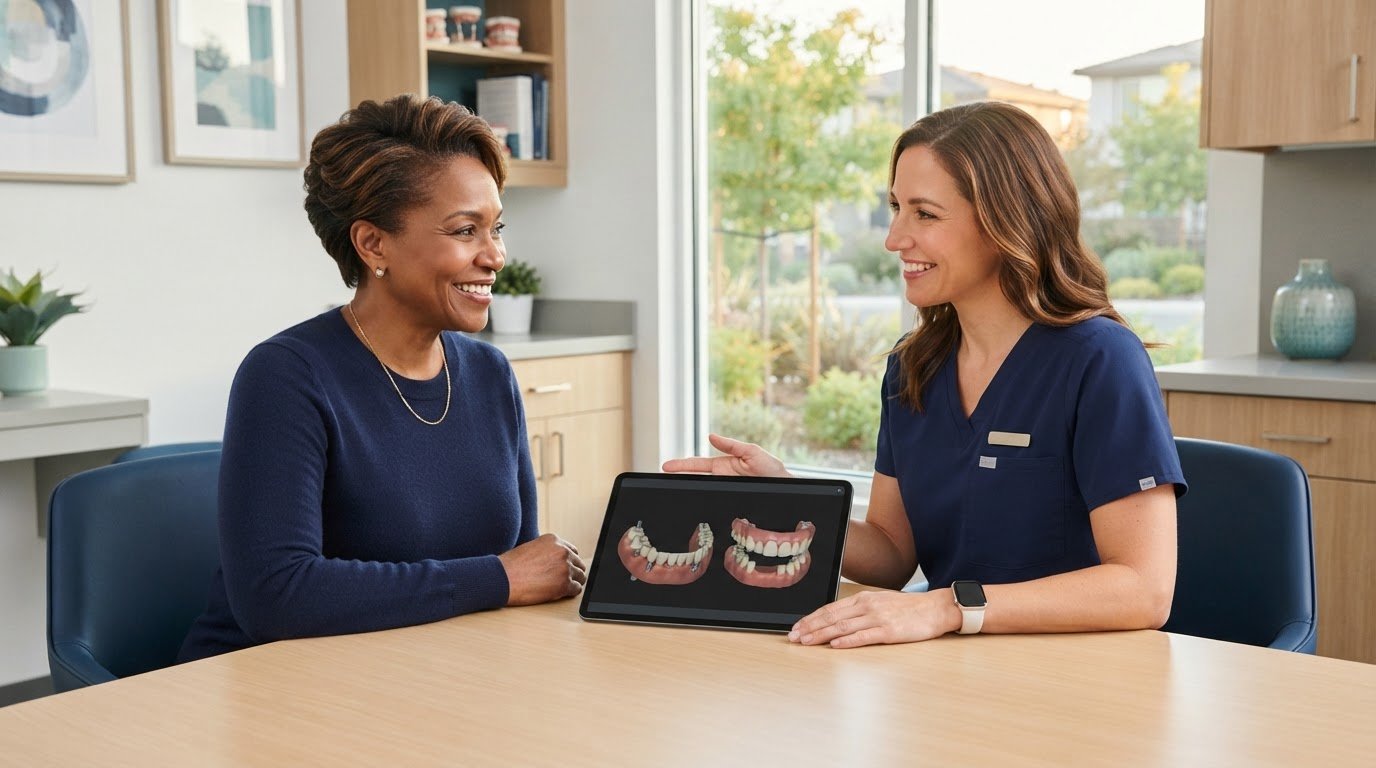

An osteoporosis diagnosis raises sensible questions about implant healing, but it does not automatically rule implants in or out. At Galleria OMS in Roseville, the assessment considers the particular jaw site, oral health, medical history and current and past medications together.
This guide from Galleria OMS provides general education. Diagnosis, treatment suitability and timing require an individual examination; results vary.
Key takeaways
- General bone density and the condition of a proposed jaw site are related but distinct issues.
- Report past osteoporosis medicines as well as current prescriptions.
- Never stop, delay or change a dose on your own to prepare for dental surgery.
- Some cases need coordination between the implant surgeon and prescribing clinician.
What a diagnosis can—and cannot—tell the surgeon
Osteoporosis describes reduced bone strength and increased fracture risk. It does not specify how much usable bone exists at every possible implant location. Two patients with the same diagnosis can have very different oral findings and treatment histories.
Dental examination and appropriate imaging assess the proposed site and surrounding structures. A dental scan is not a substitute for medical testing used to diagnose or manage osteoporosis throughout the body. Share relevant information from your medical clinician, but do not assume one bone-density result settles implant candidacy.
| Information | Why it matters | What to provide or ask |
|---|---|---|
| Osteoporosis or osteopenia diagnosis | Gives context for medical history | What have you been told about your bone health? |
| Jaw-site findings | Shows local dimensions and nearby anatomy | Is adequate support present for the intended restoration? |
| Current and past medicines | May affect risk assessment and care coordination | Names, doses, route, duration and most recent dose |
| Reason for medication | Osteoporosis and cancer-related regimens can differ substantially | Which condition is being treated and by whom? |
| Previous oral healing problems | Adds relevant clinical history | Prior extractions, exposed bone or persistent symptoms |
Why antiresorptive medicines require discussion
Bisphosphonates and denosumab are examples of antiresorptive medicines. They can be relevant because of medication-related osteonecrosis of the jaw, often abbreviated MRONJ, a serious complication involving impaired jawbone healing. Risk varies with the drug regimen, reason for treatment, duration, other therapies and patient factors.
Medication use is not a reason to assume the same risk for everyone. Higher-dose regimens used for some cancer conditions require a different discussion from many osteoporosis regimens. Tell your surgeon why the drug was prescribed rather than reporting only its name.
Do not arrange your own medication break
Stopping a medicine is not a universal way to make implant surgery safer. Any possible change must account for the condition being treated and the consequences of interruption. Delaying or stopping denosumab without a medical plan can increase fracture risk.
If timing needs consideration, the prescribing clinician and oral surgeon should coordinate it. There is no safe medication-holiday schedule that this article can give you. Continue following your prescriber’s instructions unless your treating clinicians agree on a different plan.
Prepare a useful medication history
Bring a list with medicine names, dose and route, approximate start and stop dates, and the most recent injection or infusion date when relevant. Past treatment still matters. If you do not remember a detail, say so and ask the prescribing office or pharmacy to help confirm it.
Also report steroids, cancer therapies, other health conditions and previous dental healing problems. Do not send sensitive medical records through a public contact message; ask the practice how to transfer them securely.
Discuss alternatives and monitoring
The assessment may support implant planning, recommend additional coordination or favor a different restoration. Ask how the expected benefits compare with the risks in your situation and what follow-up is needed. No general diagnosis guarantees a particular healing timeline.
Report persistent pain, drainage, exposed bone or a nonhealing area promptly. These symptoms have more than one possible cause and require professional assessment, not self-diagnosis. Learn about implant surgery and bring questions specific to your health history.
Frequently asked questions
Can people with osteoporosis receive implants?
Some can, after individualized assessment. The diagnosis alone is not enough to establish suitability.
Does past bisphosphonate use still matter?
Yes. Include prior treatment in your history even if you no longer take the medicine.
Should I postpone an injection until after the consultation?
Do not change the schedule independently. Contact your prescribing clinician and the dental team if you need advice about timing.
Discuss your options with Galleria OMS
Request a consultation with our Roseville team or call 916-783-2110. Our office is at 911 Reserve Drive, Suite 150, Roseville, CA 95678. Bring your questions and available records so we can discuss the surgical findings and coordinate with your restorative dentist.