
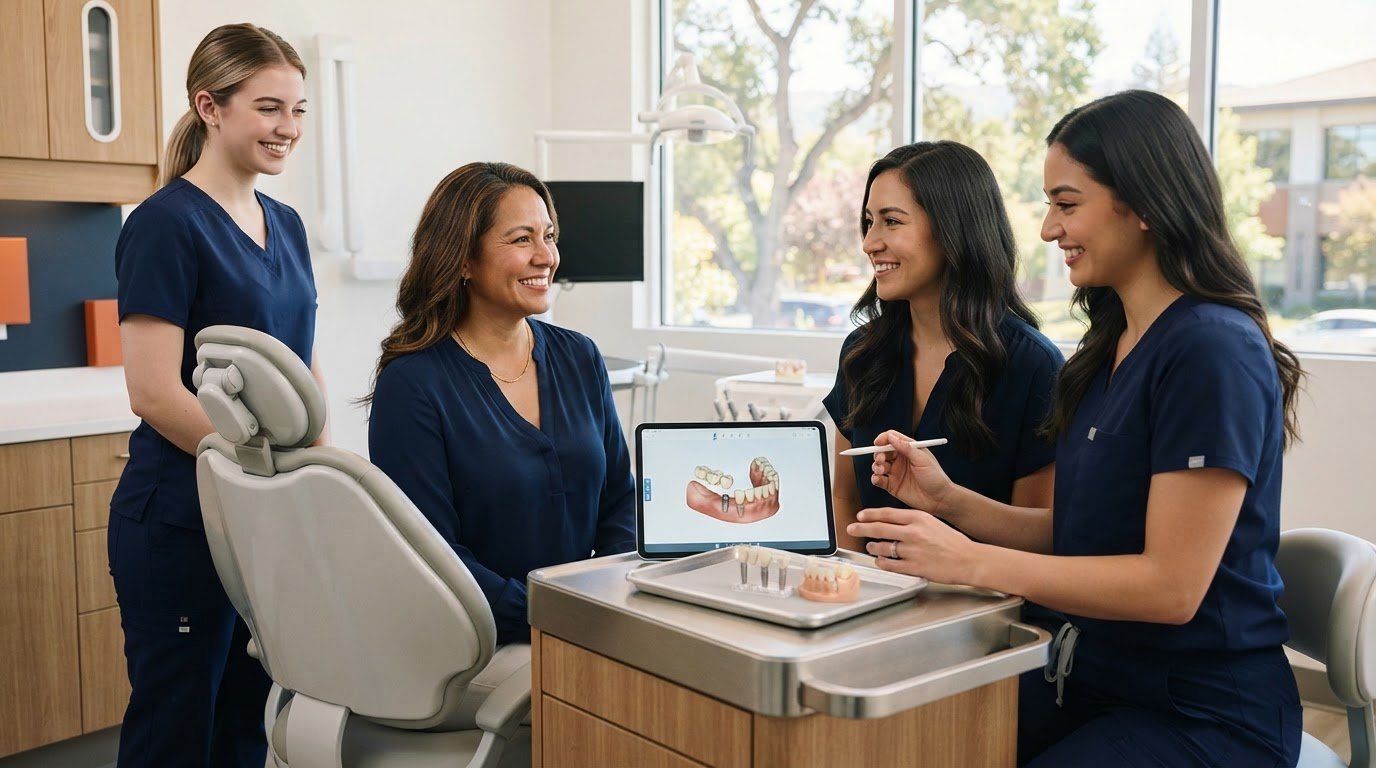
Searching for an “implant dentist in Roseville” can make it sound as though one title tells you everything about a practice. It does not. Implant treatment involves diagnosis, surgical placement, the replacement tooth or teeth and long-term maintenance. Sometimes one clinician provides several stages; sometimes a coordinated team is the better fit.
Galleria Oral & Maxillofacial Surgery provides the surgical perspective in Roseville and can coordinate with the dentist responsible for your restoration. Choosing care becomes easier when you know who is accountable for each step—not just who appears first in a search result.
Key takeaways
- “Implant dentist” describes a focus of care, not a complete statement of qualifications.
- The final restoration should guide planning before implant surgery.
- Know who handles temporary teeth, adjustments and long-term checks.
- Compare written plans and communication as well as credentials and fees.
Start with the problem you need solved
A single missing molar, a visible front-tooth gap and a loose full denture call for different conversations. Explain what matters most: chewing, appearance, comfort, avoiding a removable appliance or preserving adjacent teeth. Your goals help define the questions, but an examination determines which options are appropriate.
Ask about nonsurgical and tooth-preserving alternatives when relevant. Implant care should not begin with an assumption that every remaining tooth needs removal. Your clinician should explain why a particular approach fits the condition of your mouth.
Map responsibilities before committing
| Stage | Responsibility to clarify | Question to ask |
|---|---|---|
| Diagnosis and planning | Align the surgical position with the intended teeth. | Have the surgeon and restorative dentist agreed on the plan? |
| Surgery | Place implants and manage surgical healing. | Who performs my procedure and postoperative reviews? |
| Temporary restoration | Provide and adjust teeth during healing when appropriate. | Whom do I call if the temporary appliance is uncomfortable? |
| Final restoration | Make and fit the crown, bridge or denture. | Who confirms the bite and demonstrates cleaning? |
| Maintenance and repairs | Monitor tissues and prosthetic components. | Where will I receive ongoing care and urgent assessment? |
Check qualifications without relying on labels
Ask about the clinician’s license, training and experience with treatment similar to yours. If board certification is mentioned, clarify the certifying board and how to verify it. Oral surgeons, restorative dentists and other appropriately trained professionals may contribute different skills to implant care.
Galleria OMS provider information is available for Dr. Alexander Antipov and Dr. André-David Kahwach. Use profiles as a starting point for questions about your own treating clinician and proposed procedure, not as a substitute for consultation.
Look for restoration-led planning
An implant should be planned in relation to the tooth or teeth it will support. Position, available space, gum shape and bite all influence the result. Ask how the team shares records and confirms the intended restoration before surgery.
For a front tooth, appearance and tissue contours may be especially important. For a full arch, cleaning access and the relationship between upper and lower teeth need careful attention. The same surgical description does not mean the same restorative design will suit every patient.
Ask how uncertainty is handled
Good planning includes possibilities that may change the sequence: insufficient bone, a need for additional healing or inadequate stability for immediate temporary teeth. Ask what the alternative plan would be and how you would be informed.
Be cautious about guarantees of pain-free care, universal same-day teeth or lifetime results. A useful explanation acknowledges risks and gives you practical instructions for preparation and recovery. It should also leave room for questions and a second opinion.
Compare written estimates across the whole team
Confirm whether quoted fees include implant placement, connector components, temporary teeth and the final restoration. Ask about anesthesia, imaging, grafting and review visits. If multiple offices are involved, separate estimates may be appropriate, but you should understand the combined scope.
Insurance benefits and financing terms require individual verification. An advertised monthly payment is not the total treatment price. Review financing information with questions about approval, interest, fees and total repayment.
Think beyond the final appointment
Ask how frequently you will need maintenance and who keeps the implant brand and component records. Find out how a loose crown, broken attachment or tissue concern will be assessed. A team that clearly explains ongoing care helps you plan for the full responsibility of an implant restoration.
Your ability to use cleaning tools and attend reviews matters too. If dexterity, travel or other practical issues make a design difficult to maintain, raise them early. A restoration that looks appealing should also be manageable in everyday life.
Frequently asked questions
Do I need to change my regular dentist?
Not necessarily. Ask whether your dentist provides the intended restoration and how they would coordinate with the surgical team.
Is care in one office always better?
No. The important factors are appropriate qualifications, clear responsibilities and reliable communication, whether care takes place in one office or several.
What should I bring to my first visit?
Bring available dental records, a medication list, existing treatment proposals and the questions that matter most to you. The practice can advise which records are needed.
Meet your surgical team in Roseville
Learn about dental implant surgery at Galleria OMS, request a consultation or call 916-783-2110. This guide is general information; a personalized recommendation requires a clinical evaluation.