
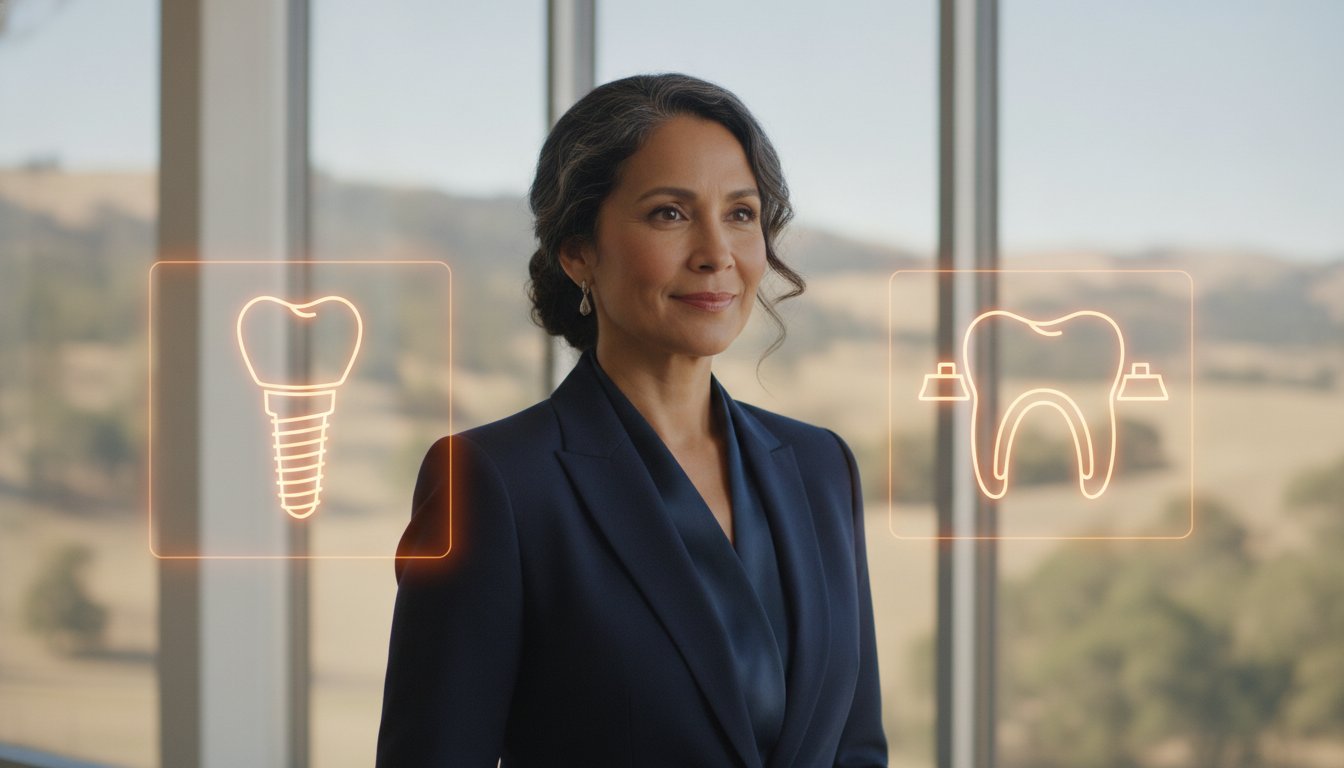
One missing tooth can lead to two very different treatment plans. A traditional bridge borrows support from neighboring teeth. An implant replaces the missing root with a surgically placed support for a crown. Both can close the gap; neither is the right answer for everyone.
This article is educational and does not replace a dental examination, imaging, or a personalized treatment recommendation. Outcomes and timelines vary, and both restorations need continuing care.
At Galleria Oral & Maxillofacial Surgery in Roseville, patients from Sacramento and surrounding communities often arrive with a question framed as “bridge versus implant.” A better starting point is to examine the gap, the teeth beside it, the bone underneath it, and your priorities. Consider two examples: one person has untouched neighboring teeth and healthy bone; another has already-crowned teeth on either side and limited bone. The same missing premolar can call for a different discussion in each case.
Key Takeaways
- A conventional tooth-supported bridge generally requires preparing the adjacent teeth; an implant crown is independently supported by an implant in the jaw.
- A bridge avoids implant surgery, but the missing-tooth site has no replacement root; an implant may help maintain bone locally without stopping all bone changes.
- Healthy bone, gum health, medical history, bite forces, and adjacent-tooth condition all influence the decision.
- Compare written treatment plans for included procedures, expected stages, cleaning, repair, and follow-up rather than assuming one solution is always cheaper or longer lasting.
Start With the Supporting Structures
In a conventional three-unit bridge, the artificial tooth in the middle is joined to crowns on teeth beside the space. Those “abutment” teeth must be shaped to hold the crowns. If they already need crowns because of extensive fillings or damage, that may be a reasonable use of existing support. If they are intact, removing enamel deserves careful consideration because that preparation cannot be undone.
A single-tooth implant takes another route. A post is placed in the jaw; after appropriate healing and assessment, an abutment and crown complete the restoration. Neighboring teeth generally do not need to be prepared to support it. But the site must offer a suitable foundation, and surgery brings its own risks, follow-up needs, and possible preparatory procedures. Learn more about the components and planning involved on our dental implants page.
| Decision point | Traditional bridge | Implant crown |
|---|---|---|
| Where support comes from | Prepared neighboring teeth | Implant anchored in jawbone |
| Neighboring teeth | Usually receive crowns | Usually remain unprepared for this restoration |
| Missing-tooth bone | No root replacement at the gap | Implant transmits functional loading to local bone |
| Treatment steps | Tooth preparation and prosthetic fabrication | Surgical placement, healing, and crown fabrication |
| Daily cleaning | Clean under pontic and around crowned teeth | Clean around crown and implant gumline |
The Questions That Actually Separate the Choices
What shape are the teeth on either side?
Suppose your missing tooth sits between two teeth that already need crowns. A bridge may address all three positions in one prosthetic plan. Now suppose those teeth have small or no restorations. The cost of preparing healthy enamel may carry more weight. The state of those teeth should be documented before choosing based on the appearance of the gap alone.
What is happening below the gumline?
After a tooth is removed, its surrounding ridge may change shape. A bridge fills the visible gap but does not put a root back into that site. An implant can provide functional stimulation to the local bone, but it cannot reverse all prior bone loss or guarantee the ridge will never change. If bone has narrowed, grafting might be part of implant planning. The available space between roots, location of nerves or sinuses, and gum condition also matter.
What is your realistic treatment window?
A bridge usually avoids the period needed for an implant to integrate with bone. Implant treatment may involve extraction, possible grafting, placement, healing, and then crown fabrication. Some sites allow different sequences, but faster is not always appropriate. Ask what interim tooth options exist if the gap is visible. Immediate implant placement or a same-day provisional crown is conditional on site characteristics and stability, not an entitlement for every patient.
How will you clean and maintain it?
Food and plaque can collect beneath a bridge pontic, so a floss threader or other device may be needed. Implant crowns need cleaning at the gumline and monitoring for inflammation or mechanical issues. Neither option is “install and forget.” Grinding, a difficult-to-clean design, or inconsistent follow-up can affect either restoration. Your restorative dentist can demonstrate the specific technique before you commit.
Comparing a Written Plan Without Guesswork
Request an itemized explanation from your care team. For a bridge, ask which teeth will be prepared, whether they need treatment for any other reason, and what happens if one supporting tooth later develops decay. For an implant, ask whether the plan includes imaging, extraction, grafting if needed, surgery, abutment, provisional restoration, and final crown. If treatment is coordinated across offices, confirm who is responsible for each stage.
Financial comparisons should include potential repairs and professional maintenance without claiming a fixed lifespan for either option. Insurance policies vary in what they cover; an estimate of benefits is not a guarantee of payment. If you consider financing, review the actual terms, total repayment, and approval requirements. Our financing information is a starting point for questions, not a substitute for your own written estimate.
Three Common Scenarios
Intact adjacent teeth: An implant may be appealing because a conventional bridge would require reshaping teeth that otherwise need no crowns. Confirm that the implant site is suitable before making a decision.
Already-restored neighboring teeth: If both teeth need crowns anyway, a bridge may fit the broader restorative plan. Assess whether those teeth are strong enough to support it and whether the space can be cleaned effectively.
Limited bone or complex medical history: A bridge may avoid surgery, while grafting or staged implant treatment may still be possible. Neither option should be selected solely because of a quick impression from a photograph. Our second-opinion guide can help organize records and questions if recommendations differ.
Frequently Asked Questions
Is a bridge always faster than an implant?
Often a conventional bridge has fewer surgical stages, but lab scheduling and dental work on supporting teeth vary. An implant may need months of healing, especially if grafting is involved. Your dentist can give you a case-specific sequence.
Can I replace an old bridge with an implant?
Sometimes. The health of the crowned teeth, size of the gap, and remaining bone all need evaluation. Removing a bridge does not automatically leave enough space or bone for implant placement.
Does an implant prevent all jawbone loss?
No. Implants provide local loading, but bone and gum contours can still change with age, disease, or other factors. An implant does not eliminate maintenance or the possibility of future treatment.
Does a bridge damage healthy teeth?
A conventional bridge requires irreversible preparation of its supporting teeth. Whether that is a worthwhile trade-off depends on their existing condition and the alternatives available. Ask your dentist to show which surfaces would be prepared.
Which option is more likely to be covered by insurance?
Coverage depends on your plan, waiting periods, exclusions, and benefit limits. Have your dental team review your specific policy and request a written estimate; avoid assuming either treatment is covered in full.
Get a Site-Specific Opinion
Your general dentist can evaluate the neighboring teeth and final restoration; Galleria Oral & Maxillofacial Surgery in Roseville can assess the surgical implant option. We welcome patients from Sacramento, Rocklin, and neighboring cities to our Roseville office. Request a consultation to discuss what your anatomy and goals allow before choosing between a bridge and an implant.