A complicated implant history does not call for a more confident sales pitch. It calls for a clearer explanation of the problem, the alternatives and the uncertainties. Galleria OMS in Roseville welcomes Sacramento-area patients seeking a surgical evaluation when bone loss, previous treatment or broader reconstruction makes planning more involved.
This guide from Galleria OMS provides general education. Diagnosis, treatment suitability and timing require an individual examination; results vary.
Key takeaways
- “Complex” can refer to anatomy, prior treatment, health or restorative requirements.
- The reason for a previous problem matters before choosing another procedure.
- Implant number is only one part of full-arch planning.
- A useful consultation explains what can be decided now and what requires further information.
Define the problem before selecting the procedure
One patient may need reconstruction of a narrow ridge. Another may have a bridge that cannot be cleaned easily. A third may have an implant that lost support. These are different problems even if all are described as complex implant cases.
Your assessment should identify whether the main issue is surgical, restorative, biological or a combination. Treatment names such as All-on-4 do not replace a diagnosis. The goal is a useful, maintainable restoration with risks you understand.
| Challenge | Assessment focus | Planning question |
|---|---|---|
| Reduced bone | Dimensions and nearby nerves or sinus | Is preparation needed, or is another approach reasonable? |
| Previous implant loss | Possible causes and current site condition | What would change before another implant is considered? |
| Existing bridge problems | Fit, components, bite and cleaning access | Is restoration repair sufficient or is surgical care also needed? |
| Full-arch tooth loss | Implant distribution and final tooth design | How will temporary and final teeth be coordinated? |
| Medical or medication concerns | Healing risks and relevant prescribing clinicians | Is additional coordination necessary before surgery? |
Use records to understand the history
Bring previous plans, operative information, implant component details and imaging when available. Explain what happened after earlier procedures and which symptoms persist. The history may suggest questions to investigate, but it does not establish the cause without examination.
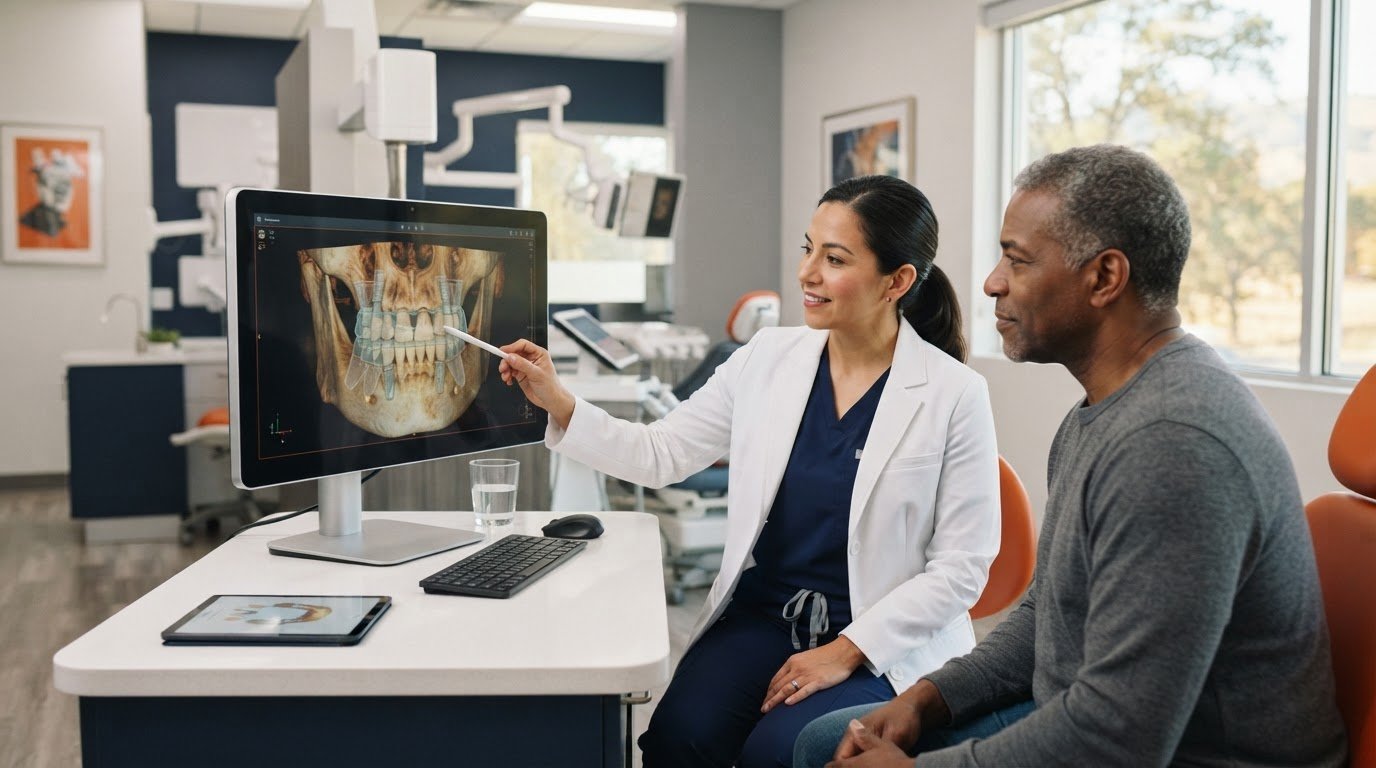
Appropriate new imaging may be necessary even when old scans exist. A three-dimensional study can clarify anatomy, but it cannot by itself predict healing or guarantee a treatment outcome.
Compare options on the same clinical basis
Depending on findings, discussion may include bone grafting, staged implant care, restoration changes or non-implant alternatives. Specialized techniques are not suitable for every anatomy or health situation.
For full-arch treatment, four versus six implants is not a simple ranking. Distribution, bone, bite and restoration design all matter. Ask why a proposed configuration fits your case and what it would support. All-on-4 information is a starting point, not a personal treatment recommendation.
Ask how the team will manage uncertainty
Some decisions depend on healing or findings during surgery. Ask what would lead to a changed plan and how that affects temporary teeth, return visits and fees. Immediate fixed temporary teeth cannot be promised merely from a treatment label.
The restorative dentist and surgeon should agree on the desired final result before placement. Clarify who makes the temporary restoration, who adjusts it and who evaluates readiness for the final teeth. Written responsibilities are particularly useful when several offices are involved.
A second opinion should clarify, not guarantee
If another provider said implants were unsuitable, ask for the reason and bring it to the evaluation. A second opinion may identify a different pathway or confirm the same limitation. Neither outcome means the consultation was wasted.
Be cautious about anyone guaranteeing that every failed implant can be replaced or every patient can avoid grafting. Ask about benefits, limitations, alternatives and the consequences of declining treatment. You should have time to understand irreversible steps such as extraction.
Frequently asked questions
Does a previous failure mean another implant will fail?
Not inevitably, but it is important to investigate contributing factors and reassess the site. Another implant may or may not be appropriate.
Will all treatment happen at Galleria OMS?
The plan may involve coordination with your restorative dentist or other clinicians. Confirm which practice performs and bills for each stage.
Can I receive a plan without an examination?
Records may help prepare a discussion, but a personalized surgical recommendation requires an appropriate clinical assessment.
Discuss your options with Galleria OMS
Request a consultation with our Roseville team or call 916-783-2110. Our office is at 911 Reserve Drive, Suite 150, Roseville, CA 95678. Bring your questions and available records so we can discuss the surgical findings and coordinate with your restorative dentist.