A guide to jawbone health and implant eligibility from the board-certified oral surgeons at Galleria Oral & Maxillofacial Surgery in Roseville, CA — serving Rocklin, Granite Bay, Folsom, Lincoln, El Dorado Hills, and the greater Sacramento region.
This article is general education. Only a 3D imaging evaluation can determine your actual bone volume and the options that fit your case.
Being told you aren't a candidate for a permanent smile because of jawbone depletion is a devastating blow — yet it's rarely the final word. Many patients arrive at our office feeling defeated by the idea that their anatomy has failed them, anxious about the complexity of restorative surgery, or self-conscious about the subtle facial changes that follow tooth loss. Understanding how bone loss affects dental implants is the first step toward reclaiming your confidence.
In this guide, you'll learn how jawbone density impacts implant eligibility, why bone grafting isn't as intimidating as it sounds, and the sophisticated workarounds board-certified surgeons use — even after significant resorption. You don't have to settle for a "no" when modern surgery offers a reliable path forward.
Key Takeaways
- Your jawbone is the foundation for titanium implant posts, which fuse to living bone through osseointegration.
- Sufficient bone density is critical for long-term implant stability — it's the first thing evaluated at any consultation.
- Traditional dentures can actually accelerate bone loss; implant-supported restorations provide the internal stimulation the jaw needs to stay healthy.
- Bone grafting, sinus lifts, and All-on-4 techniques let surgeons rebuild or work around depleted bone.
- 3D CT imaging lets board-certified surgeons plan complex cases with precision — and often turns a past "no" into a workable plan.
The Critical Connection Between Jawbone Health and Dental Implants
A dental implant isn't just a replacement tooth; it's a structural system. Think of your jawbone as the foundation of a house — without a solid, dense base, the structure above can't remain stable under pressure. Healthy bone provides the support for biting and chewing forces, ensuring your restoration feels and functions like the real thing.
Success relies on osseointegration — the process by which living bone tissue fuses directly to the titanium post. During placement, the surgeon's goal is "primary stability": anchoring the implant firmly enough to resist even microscopic movement while your body builds new bone around it. Without sufficient bone volume, that fusion can't happen effectively, which is why density is the first thing assessed on your journey.
What Is Jawbone Resorption?
Bone is living tissue that constantly remodels itself in response to force. Tooth roots transmit chewing pressure into the jaw thousands of times a day, and that stimulation tells the body to keep the bone dense. When a tooth is lost, the signal stops — and the body begins reabsorbing the "unused" bone. Studies show the ridge can lose a significant portion of its width within the first year after an extraction, and the shrinkage continues slowly for decades. Gum disease, long-term denture wear, smoking, and certain medical conditions accelerate the process.
How Bone Loss Impacts Your Dental Implant Eligibility
An implant needs to be completely encased in bone — ideally with 1 to 2 millimeters of bone surrounding the post on all sides, which for most implants means a ridge roughly 6 millimeters wide, with adequate height above nerves and sinuses. When resorption has narrowed or shortened the ridge, placing a standard implant without preparation risks poor stability, damage to nearby structures, or eventual failure.
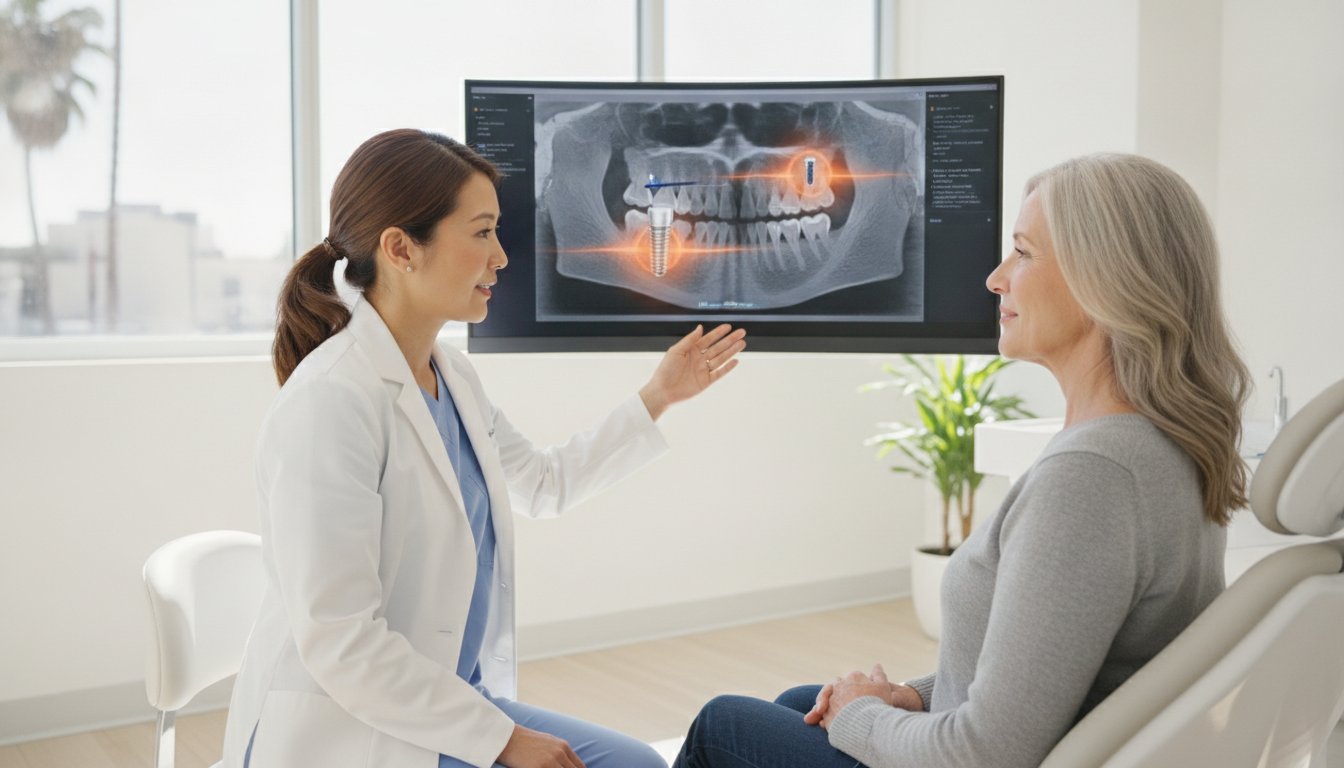
The location matters, too. In the upper back jaw, the maxillary sinus sits above the tooth roots and enlarges after teeth are lost, leaving less bone height. In the lower back jaw, the inferior alveolar nerve limits how deep an implant can go. This is exactly why a 3D cone beam CT scan — not a flat X-ray — is the standard of care for implant planning: it measures your bone in all three dimensions and maps every structure the surgeon must respect.
Important: being told "you don't have enough bone" is a description of today's anatomy, not a permanent verdict. It usually means the site needs preparation — not that implants are off the table.
Why Traditional Dentures Often Worsen Bone Loss
Here's the frustrating irony of conventional dentures: they rest on top of the gums, pressing down on the ridge without transmitting any stimulation into the bone. The pressure can actually accelerate resorption while the lack of root stimulation lets the ridge shrink beneath the appliance. That's why dentures that fit well at first grow loose over the years, need relines, and eventually contribute to the sunken facial profile associated with long-term denture wear.
Implant-supported restorations work in the opposite direction: the posts function like roots, transmitting chewing forces into the jaw and telling the bone to stay dense. It's the only form of tooth replacement that actively preserves the foundation. Read more in our guide to the types of permanent dental implants.
Modern Surgical Solutions for Patients with Low Bone Density
Bone Grafting
Grafting rebuilds lost ridge width and height by placing bone material — from your own body, a donor source, or a synthetic substitute — at the deficient site. Your body then remodels the graft into solid, living bone over three to six months. Grafts range from a small "socket preservation" placed at the time of an extraction to larger ridge augmentations, and most are far less involved than patients fear: soreness is typically comparable to a tooth extraction.
Sinus Lifts
When the upper back jaw lacks height because the sinus has expanded, a sinus lift gently raises the sinus membrane and places graft material beneath it, creating new bone height for implant placement. It's one of the most common and predictable pre-implant procedures.
All-on-4: Working With the Bone You Have
For patients missing most or all teeth in an arch, All-on-4 often avoids grafting entirely. Implants are placed in the front of the jaw where bone stays naturally denser, and the back implants are tilted to maximize contact with available bone — frequently bypassing the sinus and nerve limitations altogether. Many patients previously told they'd need extensive grafting qualify for a fixed full-arch restoration this way, sometimes with teeth attached the same day.
Zygomatic and Advanced Options
In the most severe upper-jaw bone loss, longer implants anchored in denser bone beyond the jaw itself can provide a foundation where conventional implants can't. These are specialist procedures — precisely the kind of case where a board-certified oral and maxillofacial surgeon's hospital-based training matters.
Taking the Next Step: Your Consultation at Galleria
At Galleria Oral & Maxillofacial Surgery in Roseville, every implant consultation starts with a 3D cone beam CT scan and an honest, itemized plan. Dr. Alexander Antipov and Dr. André-David Kahwach specialize in complex cases — including patients who've been told "no" elsewhere — and will show you exactly what your bone looks like, what it can support today, and what it would take to get you to a permanent smile. Explore our dental implant services and costs and financing options.
Frequently Asked Questions
How much bone is actually needed for a dental implant?
Enough to completely encase the post — ideally 1 to 2 millimeters of bone around the entire implant, which for most patients means a ridge width of roughly 6 millimeters. If your bone doesn't meet that today, grafting can build the site up to a safe environment.
Does bone grafting for dental implants hurt?
You shouldn't feel pain during the procedure itself — local anesthesia and sedation options keep you comfortable. Afterward, most patients report soreness similar to a standard extraction, peaking within the first 48 hours and managed with routine aftercare and medication.
How long does a bone graft take to heal?
Gums feel healed within a couple of weeks, but the internal transformation takes three to six months as your body converts the graft into solid, living bone. 3D imaging tracks progress and determines the right moment to place the implant.
Can bone loss be reversed without surgery?
No — jawbone resorption is a permanent biological change. A healthy diet supports existing bone but won't regrow lost volume. Surgical grafting is the only proven way to rebuild the height and width of the ridge.
What happens if I ignore bone loss after losing a tooth?
The surrounding bone progressively atrophies, neighboring teeth can loosen or shift, and the facial profile gradually sinks. Waiting also makes the eventual restoration more complex and more expensive — earlier evaluation preserves options.
Are All-on-4 implants better for people with bone loss?
Often, yes. All-on-4 places implants where bone is naturally denser and tilts the back implants to maximize contact with what's available — frequently avoiding sinus lifts and extensive grafting while delivering a full, fixed smile on a shorter timeline.
Will dental implants stop my jawbone from shrinking further?
Yes — implants are the only restorative solution that actively prevents further shrinkage. Once the post fuses with your bone, it stimulates the jaw the way natural roots do, protecting your remaining teeth and the youthful proportions of your face.
Get an Evaluation, Not a Guess
If you've been told you don't have enough bone for implants, get a second look with 3D imaging before you accept it.
Call (916) 783-2110 or schedule a consultation.
911 Reserve Drive, Suite 150, Roseville, CA 95678.