A patient guide to same-day full-arch implants from the board-certified oral and maxillofacial surgeons at Galleria Oral & Maxillofacial Surgery in Roseville, California.
This article is general education, not a treatment recommendation. Whether same-day loading is appropriate depends on an examination, 3D imaging, bone quality, medical history, and the stability achieved at surgery. Your surgeon will confirm the plan for your case.
What if you could arrive at a surgical suite with failing teeth and leave a few hours later with a complete, functional smile? For many people, dental restoration sounds like a long marathon of waiting, healing, and months in a removable temporary denture. Add worries about surgical discomfort and unclear pricing, and it is easy to keep putting the decision off, even when eating and speaking have become a daily struggle.
Same-day full-arch implants, often marketed as Teeth in a Day, were developed to replace that uncertainty with a predictable process. This guide explains how the immediate-load approach works, who qualifies even with significant bone loss, what each visit involves, and how to think about the investment, so you can explore full arch dental implants in Roseville with realistic expectations.
Key Takeaways
- "Teeth in a Day" describes an immediate-load protocol: implants are placed and a fixed provisional bridge is attached in the same visit, so you never wear a removable temporary.
- Angled implant placement, the basis of All-on-4, lets surgeons use the denser bone in the front of the jaw, which allows many patients with bone loss to avoid extensive grafting.
- The same-day bridge is a healing prosthesis. The final bridge is made after the implants have integrated, typically a few months later.
- Board-certified oral and maxillofacial surgeons are trained in both the surgery and office IV sedation or general anesthesia, which matters for complex and revision cases.
- A complete, itemized treatment plan is the best protection against surprise costs; insurance, HSA/FSA funds, and third-party financing can help with the investment.
What Is Teeth in a Day? Same-Day Implants Explained
Teeth in a Day is a surgical protocol in which a patient receives a complete, fixed set of teeth in a single clinical visit. Technically known as an immediate-load procedure, it allows the surgeon to place dental implants and attach a functional provisional bridge during the same appointment. Instead of the traditional healing period of several months before teeth are attached, the gap is bridged in a few hours.
The psychological shift is significant. Patients who arrive with failing teeth or the anxiety of a toothless smile leave with a stable, aesthetic restoration. That immediate result removes the social withdrawal and dietary limitations that usually accompany long-term dental work, and it lets you speak and smile with confidence from day one.
The Technology Behind Immediate-Load Implants
Success depends on strategic placement and primary stability. By positioning four to six implants at specific angles, the surgeon maximizes contact with your existing bone so the implants are firm enough to support a bridge immediately. High-resolution 3D cone-beam CT (CBCT) imaging maps your jaw, nerves, and sinuses before surgery, and a digital surgical guide translates that plan into the operating room. Over the following months, osseointegration, the biological fusion between bone and implant surface, turns that initial mechanical stability into a permanent foundation.
Benefits of Choosing Same-Day Restoration
- No removable temporaries: you avoid the "flipper" or interim denture that can slip and irritate healing tissue.
- Bone preservation: placing implants at the time of extraction helps maintain jawbone volume and facial support.
- Fewer surgical visits: extractions, implant placement, and provisional teeth happen in one organized day.
- Faster return to life: most patients are back to normal routines within days, on a modified diet while healing.
The Teeth in a Day Process: Your Journey Step by Step
A renewed smile begins with a clear, predictable roadmap rather than a one-size-fits-all package. Every step of a full-arch protocol is planned to protect your safety and the final aesthetic result.
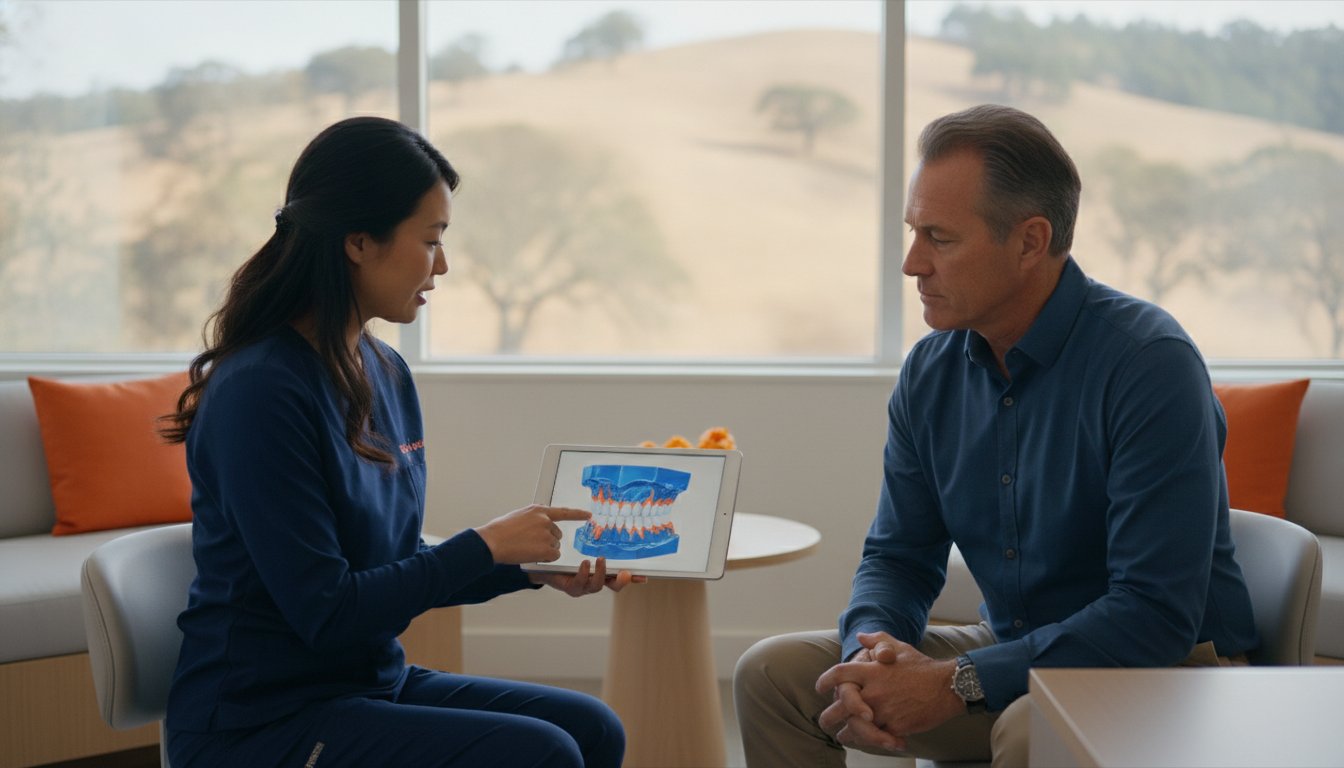
Step 1: The Digital Consultation
Precision starts long before you sit in the surgical chair. A CBCT scan lets the surgeon assess bone density and map nerve and sinus positions with sub-millimeter accuracy, which is especially valuable for patients who have been told they lack sufficient bone. From that data, a custom surgical guide is designed, essentially a GPS for the procedure that positions each implant for maximum stability. The American Dental Association notes that thorough planning is a cornerstone of a successful implant outcome. Smile design also happens at this stage, coordinating with your restorative dentist so the new teeth complement your facial proportions.
Step 2: The Surgical and Restorative Appointment
On the day of surgery, comfort comes first. IV sedation or general anesthesia, administered in the office by your oral and maxillofacial surgeon, keeps you deeply relaxed. The surgeon performs any necessary extractions, places the titanium implants according to the guide, and confirms that each one achieves the stability required for immediate loading. The provisional bridge is then attached, and you leave with a functional set of teeth.
Detailed written post-operative instructions and a recovery diet guide follow you home. Over the next several months the bone fuses with the implants; once integration is confirmed, the provisional bridge is replaced by your final, custom-crafted permanent teeth. For a phase-by-phase eating plan, see what to eat after All-on-4 surgery.
Am I a Candidate? Solving Bone Loss and Complex Cases
Many patients assume they are not candidates because they have been told their jawbone is too thin or weak. Modern techniques have changed what is possible. Even after decades in dentures or a history of severe periodontal disease, there is often a predictable path forward.
Dental Implants for Severe Bone Loss
The most frequent hurdle is bone resorption. Bone shrinks after tooth loss because it no longer receives stimulation from tooth roots. In the past that meant staged bone grafting that could add six months or more to treatment. The All-on-4 protocol tilts the rear implants to anchor into the denser bone that usually remains toward the front of the jaw, providing immediate support without extensive grafting in many cases. For the most advanced upper-jaw bone loss, zygomatic implants anchored in the cheekbone can still make a fixed same-day bridge possible.
Revision Surgery and Complex Implant Fixes
Not every restoration goes according to plan, and we regularly see patients dealing with failing work from elsewhere. Whether a previous implant has loosened, caused discomfort, or never integrated, the emotional and physical toll is real. A revision evaluation goes beyond the surface: 3D imaging and a structural analysis identify why the original work failed before a new plan is proposed. Oral and maxillofacial surgeons are specifically trained for these high-stakes scenarios, and the goal of a revision is simple: make the second restoration your last one. If you are weighing a plan from another office, our guide to implant second opinions explains what to bring and what to ask.
Cost and Financing: Planning the Investment
Full-mouth restoration is a significant decision, and financial uncertainty should not be the barrier between you and a confident smile. You deserve a clear understanding of the investment without hidden surgical fees or surprise costs later. Pricing reflects high-quality components, 3D planning technology, in-office anesthesia, and the specialized skill of a board-certified surgical team. While the upfront investment is substantial, a fixed full arch is designed to eliminate the recurring costs of failing bridges and traditional dentures.
What a Complete Quote Should Include
| Component | Questions to Ask |
|---|---|
| Diagnostics | Is the CBCT scan and digital planning included? |
| Surgery | Are extractions, implants, and any grafting itemized? One arch or both? |
| Anesthesia | Is IV sedation or general anesthesia included, and who administers it? |
| Provisional teeth | Is the same-day bridge included, and what is it made of? |
| Final bridge | Is the permanent bridge included? Acrylic, hybrid, or zirconia? |
| Follow-up | How many post-op visits and adjustments are covered? |
Financing Options for Dental Implants
Many families need to fit this investment into a monthly budget. Galleria works with established healthcare lenders such as CareCredit and Proceed Finance to offer payment plans that break the total into manageable installments, and you can typically apply before your consultation. Most dental insurance offers limited implant coverage, often toward the prosthetic teeth rather than surgery, and HSA or FSA funds can be applied to qualified treatment. Details are on our dental implant financing page, and our cost guides on All-on-4 pricing and All-on-4 vs. snap-in dentures go deeper.
Why Choose an Oral and Maxillofacial Surgeon for Same-Day Implants?
Selecting a provider for full arch dental implants is a decision that affects your health for decades. Many general dental offices offer implant services, but there is a meaningful difference between a practitioner who places implants occasionally and a surgeon whose residency training centered on jaw surgery, anesthesia, and complex reconstruction. Every element of a surgical practice, from 3D imaging to recovery protocols, is built around that same-day surgical flow.
The Board-Certified Surgical Difference
Board certification by the American Board of Oral and Maxillofacial Surgery means a surgeon has completed a four-to-six-year hospital-based residency and passed rigorous written and oral examinations. That is particularly relevant for immediate-load procedures, where the margin for error is slim and precision is everything. Dr. Alexander Antipov and Dr. André-David Kahwach treat straightforward, complex, and revision full-arch cases, giving them the experience to navigate challenging anatomy with confidence. Read more about our approach to same-day dental implants in Roseville.
Local Care for Northern California Residents
Our office in Roseville provides convenient access and streamlined follow-up for patients from Rocklin, Lincoln, Granite Bay, Folsom, El Dorado Hills, Loomis, Elk Grove, and the greater Sacramento area. Having your surgical team close to home makes the entire journey, from the initial consultation through long-term maintenance, more manageable for you and your family. If you are comparing providers, our Galleria vs. ClearChoice guide outlines the differences between a specialist surgical practice and a corporate implant center.
Frequently Asked Questions
Is the Teeth in a Day procedure painful?
The surgery itself is performed under IV sedation or general anesthesia, so you do not feel it. Most patients report soreness and swelling for several days afterward, managed with the medications and cold-compress routine in your post-operative instructions. Long-acting local anesthetic options can further reduce discomfort in the first days.
How long do same-day dental implants last?
When placed by a specialist and maintained with good hygiene, dental implants are designed as a long-term solution, with published ten-year success rates commonly above 90 percent. The bridge may need periodic maintenance, but the integrated implants provide a lasting foundation. Regular checkups and professional cleanings around the bridge are essential.
Can I eat normally immediately after the procedure?
No. The provisional bridge looks and feels stable on day one, but the implants need several months of protected healing. You will follow a liquid, then soft, diet during integration; chewing hard or crunchy foods too soon can disturb healing. Every patient receives a dietary roadmap.
What is the difference between All-on-4 and Teeth in a Day?
All-on-4 is a surgical technique using four strategically angled implants per arch. Teeth in a Day describes the timeline of receiving a functional bridge during the surgical visit. All-on-4 is frequently the method used to achieve same-day results, but same-day loading can also be done with more implants when the anatomy calls for it.
Does insurance cover same-day dental implants?
Most plans offer limited coverage, often contributing toward extractions or the prosthetic teeth rather than implant surgery. Every policy is different, so verify your benefits and annual maximum. Our team helps patients understand their coverage and financing options.
What happens if I don't have enough bone for implants?
Angled placement often allows implants to be anchored in denser remaining bone without grafting. When bone loss is more advanced, options include targeted grafting, sinus lifts, or zygomatic implants. Many patients who were previously told "no" are candidates after a specialist evaluation with 3D imaging.
Will my new teeth look natural?
Yes. The final bridge is custom-designed with your restorative dentist to complement your facial features, lip line, and gum display. Materials such as monolithic zirconia mimic the translucency of natural enamel, and the design is refined during the provisional phase so the permanent teeth reflect what you have already lived with.
How many appointments are required for the full process?
Typically four to six visits over several months: a consultation with imaging, the surgical day, a few healing checks, and the appointments to design and deliver the final bridge. The same-day procedure gives you an immediate smile, but the methodical follow-up is what ensures the implants are fully integrated before the permanent teeth are placed.
Ready to Reclaim Your Smile?
You do not have to live with failing teeth or the daily compromises of a traditional denture. With digital planning and the precision of board-certified oral and maxillofacial surgeons, a complete transformation in a single surgical day is achievable for many patients, including those who have been told they have too little bone.
Dr. Alexander Antipov and Dr. André-David Kahwach evaluate and treat full-arch implant patients at Galleria Oral & Maxillofacial Surgery in Roseville.
Call 916-783-2110 or schedule a consultation.
911 Reserve Drive, Suite 150, Roseville, CA 95678.