An upper denture has different design demands from a lower one. The palate, sinus anatomy, amount of lost tissue and relationship to the lower teeth all matter. At Galleria Oral & Maxillofacial Surgery in Roseville, implant planning should support the restoration you will actually wear—not simply a predetermined number of implants.
This Galleria OMS guide is general education, not a diagnosis or individualized treatment recommendation. Follow your treating clinician’s instructions; results and treatment schedules vary.
Key takeaways
- “Implant denture” can mean a removable overdenture or a fixed full-arch bridge.
- Implant retention does not necessarily eliminate all tissue support or palate coverage.
- Upper-jaw anatomy requires its own evaluation; a lower-jaw plan cannot simply be copied.
- Cleaning access, lip support and speech deserve attention before surgery.
Start with what bothers you about your current upper denture
Does it move when you speak? Does the palate feel bulky? Are you concerned about lip support or a visible transition near the gums? Those are useful starting points, but each may lead to a different design discussion. Bring your current appliance and explain both what works and what does not.
A dentist should assess the fit, bite and tissues before assuming implants are the only solution. An adjustment, reline or new conventional denture may address some concerns. If implants are appropriate, the goal is a coordinated surgical and restorative plan rather than a promise that every uncomfortable feature will disappear.
| Consideration | What it means | Question to ask |
|---|---|---|
| Conventional upper denture | A removable appliance supported by oral tissues, often covering the palate | Could improved fit or bite address the main problem? |
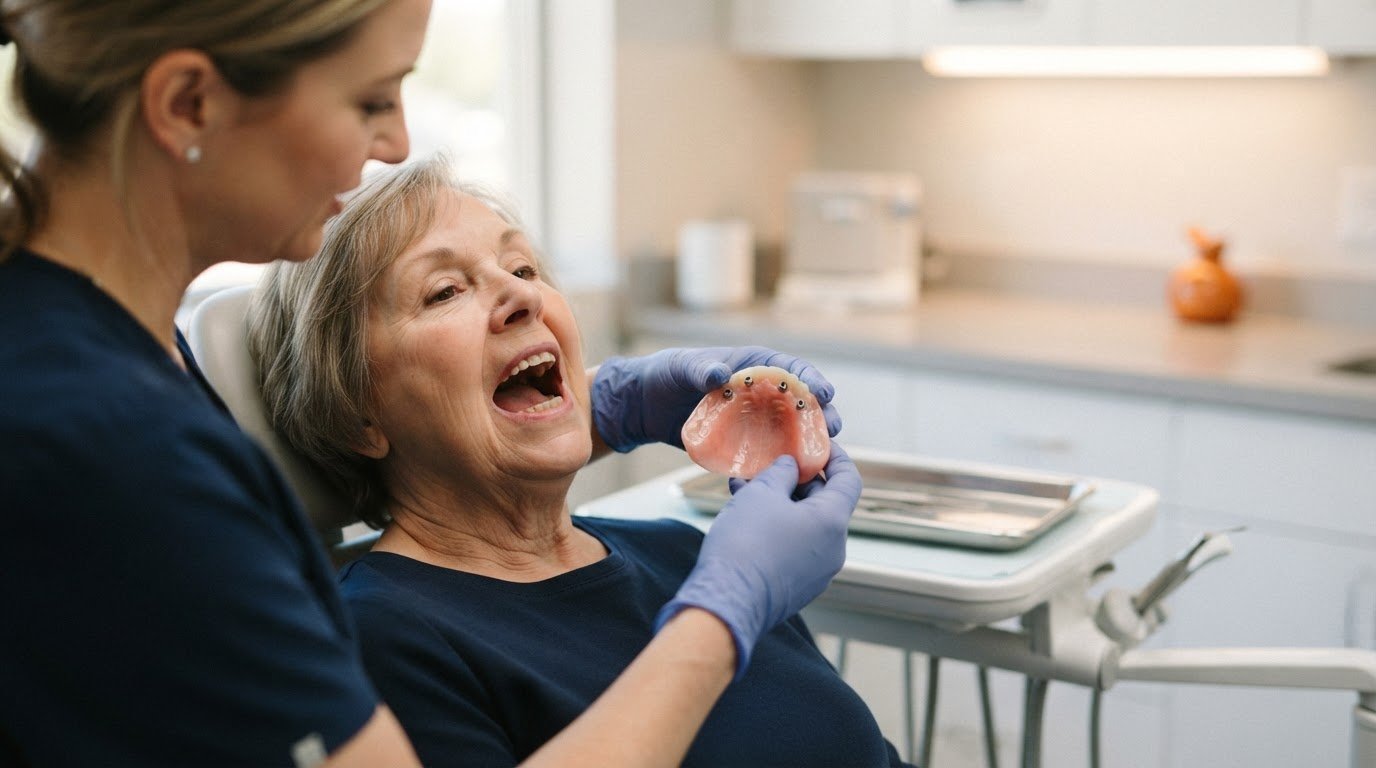
| Removable implant overdenture | Attachments provide retention; support depends on the specific design | How much palate coverage and tissue contact are needed? |
| Bar-retained design | A bar links implants and the removable denture engages with it | Is there sufficient space and access to clean around the bar? |
| Fixed upper-arch bridge | The restoration stays attached and is removed professionally when indicated | How will lip support, the gum transition and cleaning access be managed? |
Can the roof of the mouth be left uncovered?
Some implant-supported designs can reduce or eliminate palate coverage, but not every upper denture can safely be made that way. Support, available space and the structural needs of the appliance influence the recommendation. Ask what the proposed design would cover and why.
Avoid assuming that “snap-in” means palate-free or that “fixed” always means less bulk. Tissue replacement may be needed for appearance and lip support. Your restorative dentist can explain how contours influence speech, comfort and cleaning.
Why implant number is not the whole plan
The surgeon evaluates the distribution of suitable bone, nearby sinuses and the intended restoration. The upper and lower jaws differ, and the number used for one type of lower overdenture does not automatically apply above. A common treatment label is not a substitute for site-specific planning.
When bone is limited, preparation or a different approach may be considered. See our guide to severe bone loss for questions about grafting and specialized options. Those approaches have their own risks and are not appropriate for everyone.
Make cleaning and handling part of the decision
A removable denture comes out so you can clean the appliance, tissues and attachments. A fixed bridge requires cleaning underneath while it remains in place. Neither option is maintenance-free, and the easiest routine depends partly on your dexterity and the design.
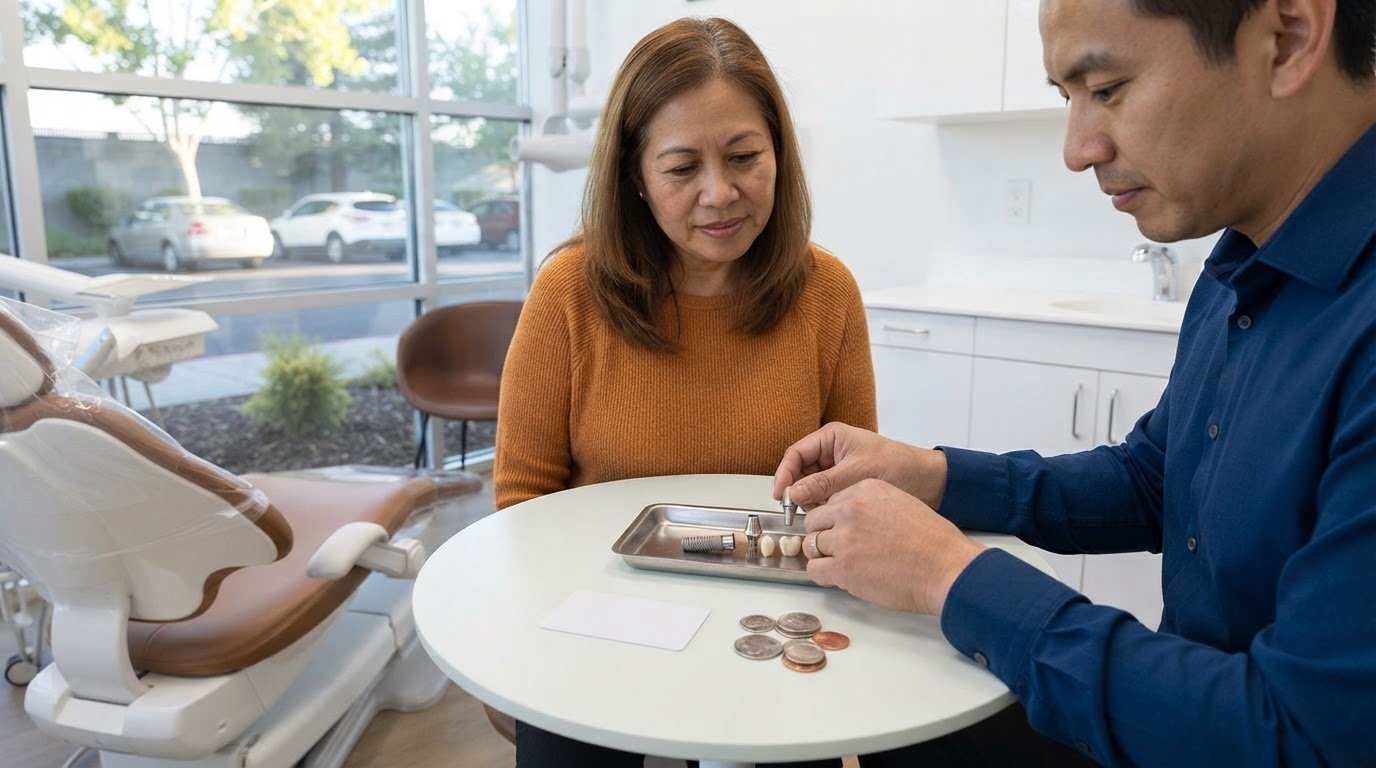
Ask for a demonstration before committing. If you have difficulty removing attachments or reaching beneath a bridge, tell the team. A restoration should be manageable on an ordinary day, not just attractive in a photograph.
Clarify the temporary phase and follow-up
The plan should explain what you will wear after surgery and when an existing denture may be used. It may need adjustment or may be unsuitable during part of healing. Never wear it over a surgical site against the clinician’s instructions.
Immediate fixed temporary teeth are possible only in selected cases. Ask what happens if the implants should heal before supporting a restoration. The final teeth, attachment maintenance and professional reviews should all appear in your discussion of treatment and fees.
Frequently asked questions
Will an upper implant denture never move?
Added retention may reduce unwanted movement, but the amount of support and behavior depend on the design. A removable appliance is not identical to a fixed bridge.
Can my current denture be converted?
Sometimes, but its condition, fit, material and available space must be assessed. A new appliance may be necessary.
Do both arches need implants?
Not necessarily. The upper restoration must work with the opposing teeth or denture, but each jaw needs its own recommendation.
Discuss an upper-arch plan in Roseville
Request a Galleria OMS consultation or call 916-783-2110. Our office is at 911 Reserve Drive, Suite 150, Roseville, CA 95678. We can discuss surgical findings and coordination with your restorative dentist. For a broader comparison, read our implant-denture attachment guide.