
Being told you have “too little bone” can leave you unsure whether any implant option remains. Severe jawbone loss can make care more complex, but the phrase alone cannot answer that question. At Galleria OMS in Roseville, planning starts with where bone is missing, what teeth need replacement and whether a safe, maintainable restoration is achievable.
This guide from Galleria OMS provides general education. Diagnosis, treatment suitability and timing require an individual examination; results vary.
Key takeaways
- The location of bone loss matters as much as its extent.
- A scan informs planning but is not a complete candidacy decision.
- Grafting and specialized implant approaches solve different problems.
- A second evaluation may identify alternatives—or confirm that implants are unsuitable.
Ask what “not enough bone” means in your case
Bone may be narrow, short or deficient in several dimensions. In the upper back jaw, the sinus can limit available space. In the lower jaw, nerve position may constrain implant placement. A strategy suitable for one site may be inappropriate elsewhere.
The intended teeth matter too. Replacing one tooth creates different design requirements from restoring an entire arch. Ask your surgeon to explain the findings in relation to the restoration, not just to point out an area on an image.
| Approach | Purpose | Important limitation |
|---|---|---|
| Localized bone grafting | Rebuild a deficient implant site | Healing and additional surgery may be needed; results are not guaranteed |
| Sinus augmentation | Create room for bone beneath the upper-jaw sinus | Applies to specific upper posterior anatomy, not every deficient site |
| Modified implant planning | Use suitable available bone with an appropriate design | Positions must still support safe anatomy and useful final teeth |
| Specialized upper-jaw implants | Consider alternative anchorage in selected severe cases | Requires specific expertise and individualized risk assessment |
| Non-implant replacement | Restore function without implant placement | Fit and support depend on the proposed denture or bridge design |
What an evaluation considers
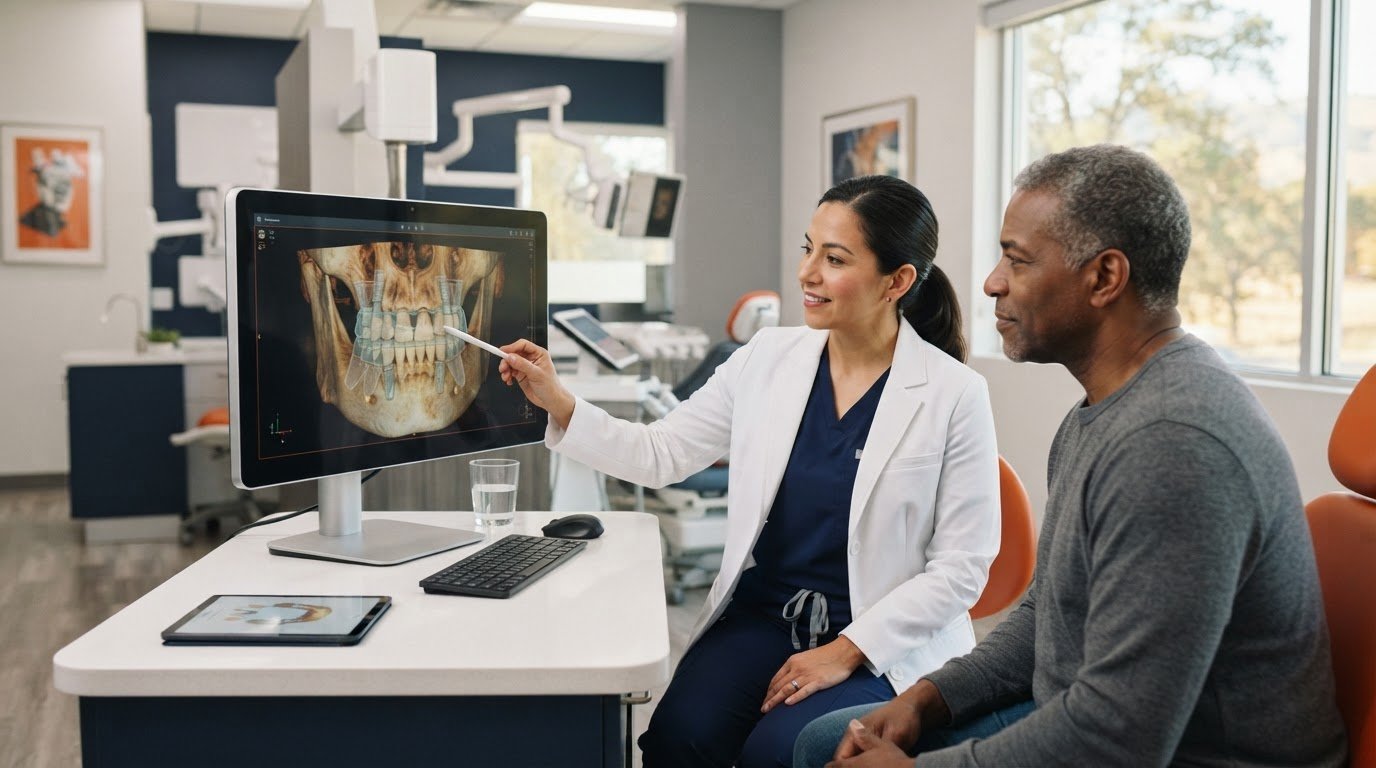
An examination assesses the remaining teeth, gums, bite and soft tissues. Appropriate imaging may include a three-dimensional scan to clarify bone dimensions and nearby structures. The surgeon interprets it alongside your medical history, medication use and treatment goals.
Active periodontal disease, smoking and conditions affecting healing may influence the plan. An osteoporosis diagnosis and localized jawbone loss are not interchangeable. Neither age nor a single image can settle the decision alone.
Understand preparation before committing to implants
If bone grafting is recommended, ask which deficiency it addresses, where the material comes from and how the team evaluates healing. In some cases grafting and placement occur together; in others, a staged approach is more appropriate.
Specialized approaches, including zygomatic implants for selected upper-jaw situations, are not universal substitutes for grafting. They have distinct anatomical considerations and risks. A qualified evaluation should compare reasonable alternatives, not promise a graft-free solution to every patient.
Bring prior recommendations to a second opinion
If another clinician advised against implants, bring their explanation, imaging and treatment records. The recommendation may reflect a particular site, procedure or health concern. A new evaluation can clarify the reason without assuming the earlier assessment was wrong.
Ask what makes a proposed alternative feasible, what uncertainty remains and what the backup plan would be. If implants are still inappropriate, discuss a non-implant restoration that addresses your most important functional concerns.
Plan the healing and temporary stages
Complex preparation can add appointments and healing time. Ask what temporary teeth are available, when they can be worn and whether they put pressure on a graft. Follow the surgeon’s instructions rather than assuming your existing denture can be used immediately.
Request a written estimate separating preparation, placement and final restorations. Ask how a change in surgical findings could alter timing or fees. A comprehensive plan is more useful than a promise of one-day treatment.
Frequently asked questions
Does years of denture use rule out implants?
No automatic rule applies. Bone changes over time, and an examination is needed to establish current options.
Can every deficient site be rebuilt?
No. Grafting has limitations and risks, and some sites or health circumstances may not support the proposed treatment.
Can implants be placed immediately after extraction?
Sometimes, but severe bone loss may change that plan. The site and stability requirements determine whether immediate placement is appropriate.
Discuss your options with Galleria OMS
Request a consultation with our Roseville team or call 916-783-2110. Our office is at 911 Reserve Drive, Suite 150, Roseville, CA 95678. Bring your questions and available records so we can discuss the surgical findings and coordinate with your restorative dentist.