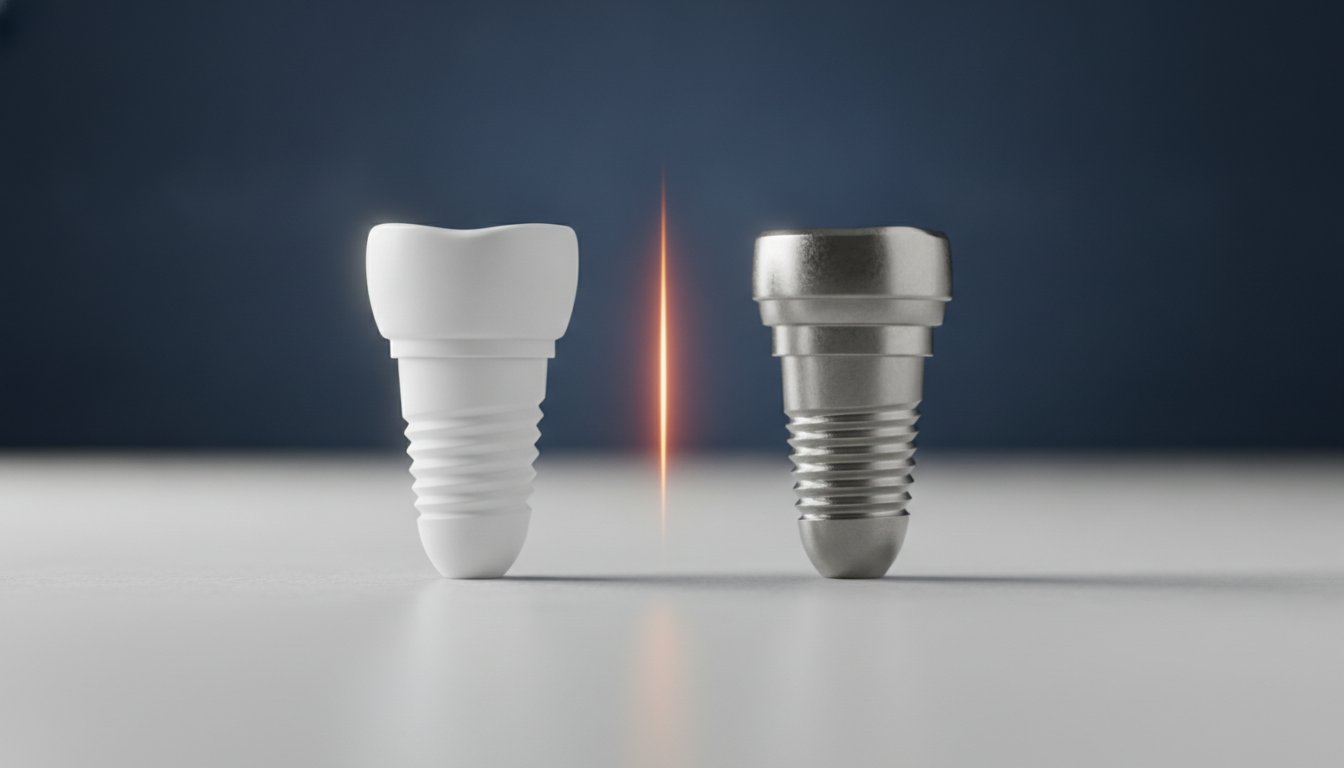
A balanced implant-material comparison from the board-certified oral surgeons at Galleria Oral & Maxillofacial Surgery in Roseville, CA, serving Rocklin, Granite Bay, Folsom, Lincoln, El Dorado Hills, and Sacramento.
This article is general education. Implant availability and suitability depend on your anatomy, restoration, and surgeon’s clinical evaluation.
Titanium has been the standard dental implant material for decades, while zirconia has emerged as a ceramic alternative for selected patients. Both materials are biocompatible and designed to integrate with jawbone, but they differ in clinical history, strength characteristics, component design, appearance, and treatment flexibility.
Choosing between them is not simply a matter of “metal versus metal-free.” The best material is the one that safely supports the planned restoration in your specific anatomy. This guide explains the practical differences so you can have a more informed conversation with your surgeon.
Key Takeaways
- Titanium has the longest clinical track record and offers extensive size, shape, and component options.
- Zirconia is a tooth-colored ceramic that may appeal to patients concerned about visible metal or documented sensitivity.
- Titanium’s two-piece systems offer more flexibility for implant angle and restoration design.
- Zirconia can provide excellent aesthetics in carefully selected cases but may be less forgiving under heavy or off-angle forces.
- Bone, gum thickness, tooth location, bite forces, and the planned crown or bridge matter more than marketing claims about either material.
Titanium and Zirconia: The Fundamentals
Titanium Dental Implants
Titanium has been used in dental and orthopedic surgery for more than half a century. Its strength, corrosion resistance, and ability to bond predictably with bone have made it the most widely studied implant material. Most modern titanium implants are made from commercially pure titanium or a medical-grade titanium alloy.
Titanium implants are commonly designed as two-piece systems: the implant post heals in the jaw, then an abutment connects it to the crown or bridge. This modular design gives restorative teams many ways to correct angles, shape the gumline, and support single teeth, bridges, or full-arch restorations.
Zirconia Dental Implants
Zirconia implants are made from zirconium dioxide, a strong, tooth-colored ceramic. Although zirconium is an element classified as a metal, zirconia’s finished ceramic form does not behave like a metal. It is nonconductive, corrosion-resistant, and generally described clinically as a metal-free implant option.
Many zirconia implants have historically used a one-piece design in which the implant and abutment are combined, though two-piece ceramic systems are also available. One-piece construction removes an implant-abutment junction but demands precise placement because there is less opportunity to correct the angle afterward.
Side-by-Side Comparison
| Factor | Titanium | Zirconia |
|---|---|---|
| Clinical history | Decades of extensive research | Shorter but growing evidence base |
| Color | Metallic gray | White, tooth-colored ceramic |
| Design flexibility | Broad range of two-piece components | Often one-piece; some two-piece systems |
| Mechanical behavior | Strong with some elasticity | Very hard but more brittle |
| Best-established uses | Single teeth through complex full arches | Selected single-tooth and aesthetic cases |
| Visibility through thin gums | Gray tone may occasionally show | White color may offer an aesthetic advantage |
Strength, Durability, and Bone Integration
Both titanium and zirconia can undergo osseointegration, the process in which living bone forms a stable connection with the implant surface. Successful integration depends on implant stability, healthy bone, controlled surgical technique, and your body’s healing response — not material alone.
Titanium combines strength with slight elasticity, allowing it to tolerate heavy and repeated forces well. Zirconia is extremely hard and wear-resistant but is a ceramic, so it is less tolerant of bending and certain lateral stresses. Modern zirconia materials are much stronger than early ceramic designs, yet titanium remains the more established choice for heavy bite forces, molar areas, patients who grind, and complex full-arch treatment.
The long-term evidence for titanium is also broader because it has been used far longer and in a much wider variety of cases. For more about maintenance and lifespan, read how long dental implants last.
Aesthetics and Gum Tissue
Zirconia’s white color can be helpful in the front of the mouth when gum tissue is thin or likely to recede. In some patients, the gray shade of titanium can become visible through very delicate tissue. That concern can often also be managed through implant position, gum grafting, a ceramic abutment, and careful crown design.
Gum health around either material still depends on cleanable contours, daily plaque control, and regular professional care. No implant material prevents gum inflammation if bacteria accumulate around the restoration.
What About Metal Sensitivity?
True titanium hypersensitivity appears to be uncommon, and titanium remains highly biocompatible for the great majority of patients. A reaction to inexpensive jewelry does not automatically mean you will react to a medical-grade titanium implant because jewelry frequently contains nickel or other metals.
If you have a documented metal allergy, a history of unexplained reactions to medical devices, or strong concerns about implant materials, discuss them before surgery. Your surgeon can review your history and determine whether further medical evaluation is appropriate. Do not rely on symptoms alone to diagnose an implant allergy.
One-Piece vs. Two-Piece Implant Design
Material is only part of the decision. A two-piece implant lets the surgeon bury the implant beneath the gum during healing when needed and gives the restorative dentist more options for abutment angle and shape. This flexibility is particularly valuable when anatomy does not allow the implant to point directly toward the final tooth.
A one-piece implant eliminates the small junction between the implant and abutment, but the visible abutment extends through the gum immediately after placement. It therefore requires excellent initial stability, precise positioning, and protection from unwanted force while healing.
Which Material May Be Right for You?
Titanium May Be Preferred When:
- You need a molar implant or have strong bite forces.
- You grind or clench your teeth.
- Your anatomy requires angle correction or a customized abutment.
- You need an implant bridge or full-arch restoration such as All-on-4.
- You value the widest component selection and longest clinical track record.
Zirconia May Be Considered When:
- A tooth-colored implant offers a meaningful aesthetic benefit beneath thin front-gum tissue.
- You have a documented sensitivity concern that has been carefully evaluated.
- Your bone and tooth position allow the precise placement required by the selected system.
- Your planned restoration and bite forces are appropriate for ceramic implant design.
Why Planning Matters More Than Material
Neither titanium nor zirconia can overcome poor implant position, inadequate bone, untreated gum disease, or an overloaded bite. A 3D cone beam CT scan lets the surgeon measure bone, map nearby nerves and sinuses, and select an implant position that supports both biological health and the final crown.
If bone volume is limited, grafting may create a healthier foundation before implant placement. Learn more about how bone loss affects dental implants and review our complete dental implant services.
Frequently Asked Questions
Is zirconia more likely to crack than titanium?
Zirconia is a strong ceramic, but it is more brittle and less flexible than titanium. Case selection and bite-force management are important, particularly for back teeth and patients who grind.
Can zirconia implants be used with significant bone loss?
Possibly, but sufficient bone and precise placement are especially important. A graft may be recommended first, depending on the implant system and the location being restored.
Are zirconia implants completely metal-free?
Zirconia is zirconium dioxide. Although zirconium is classified as a metal element, the finished zirconia material is an oxide ceramic with nonmetallic properties and is commonly described clinically as metal-free.
Can zirconia implant posts be used for All-on-4?
Titanium posts are more commonly used for All-on-4 because their modular components support the angle correction required in full-arch treatment. A final bridge may still use zirconia as the visible restorative material.
Which material lasts longer?
Titanium has the stronger long-term evidence base because it has been studied for many more decades. Zirconia can also perform well in selected cases, but no material’s lifespan can be guaranteed.
Choose the Right Plan, Not Just a Material
The most predictable implant is one selected and positioned for your anatomy, bite, and final restoration. At Galleria, we use clinical examination and 3D imaging to explain the available choices and why a particular design is recommended.
Call (916) 783-2110 or schedule an implant consultation.
911 Reserve Drive, Suite 150, Roseville, CA 95678.