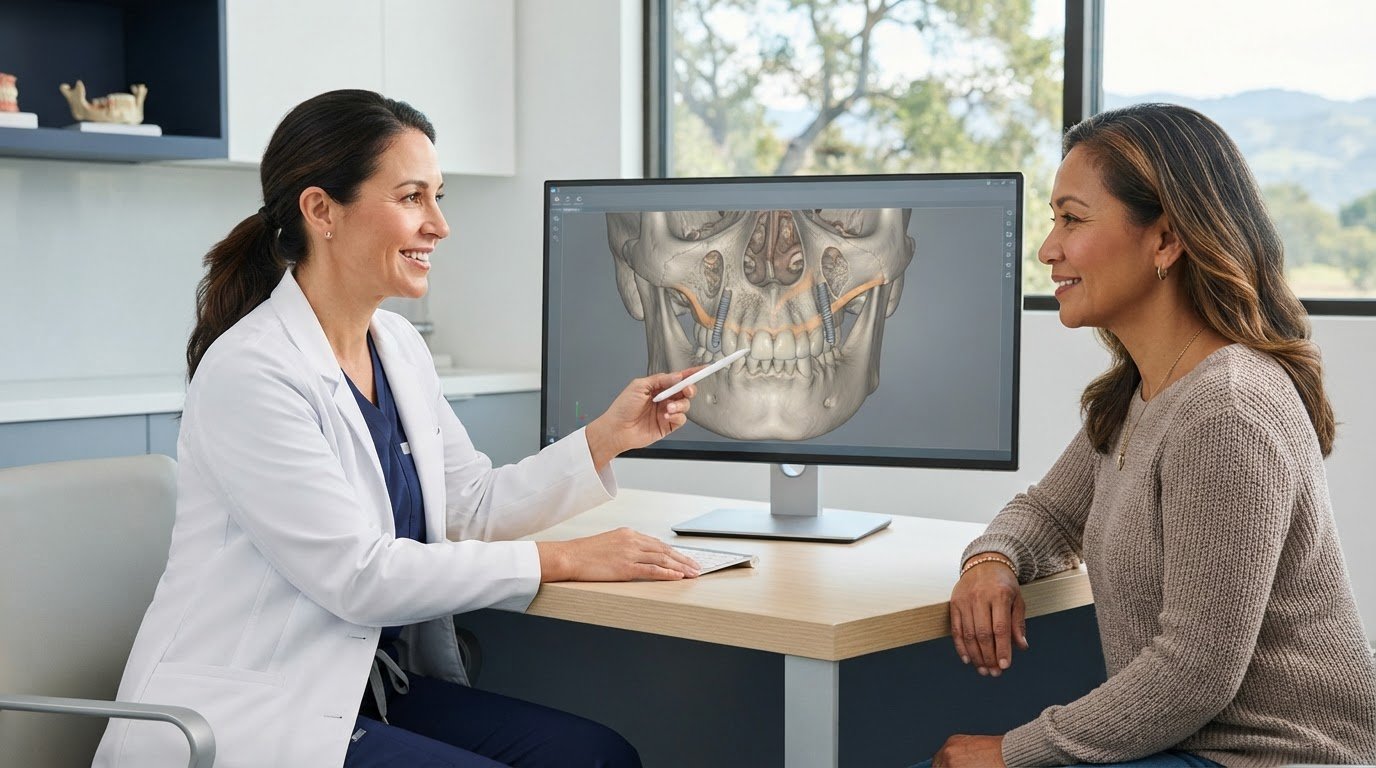

“Failing teeth” describes a concern, not a complete diagnosis. A cracked tooth, recurrent decay and advanced gum disease can require different decisions. At Galleria OMS in Roseville, implant planning should begin with an explanation of which teeth can be maintained and why replacement is being considered for others.
General education from Galleria OMS. Your examination, health history and treatment plan determine appropriate care. Follow your treating clinician’s instructions; individual results vary.
Key takeaways
- Extraction is irreversible; ask about reasonable tooth-preserving alternatives.
- One compromised tooth does not automatically call for a full-arch plan.
- The final replacement should guide the surgical plan from the beginning.
- Temporary teeth, healing and ongoing care belong in the discussion before treatment.
Ask for a tooth-by-tooth explanation
A tooth may need evaluation by your general dentist, an endodontist or a periodontist before its long-term outlook is clear. Root canal care, restorative treatment or periodontal therapy may be appropriate in some cases. In others, damage or loss of support can make preservation unrealistic.
Ask what findings support the recommendation, what uncertainty remains and how keeping the tooth compares with replacing it. A useful consultation should help you understand the reasoning rather than only present a package of procedures.
| Situation or option | What it involves | What to clarify |
|---|---|---|
| A damaged but maintainable tooth | Restorative or other tooth-preserving care | What treatment is needed and what is its expected outlook? |
| One nonrestorable tooth | Extraction and evaluation of a single-tooth replacement | Could an implant, bridge or removable option fit? |
| Several adjacent compromised teeth | A coordinated plan for the gap and remaining teeth | Which supports are suitable for the planned restoration? |
| Extensive tooth loss or poor remaining support | Possible full-arch or removable rehabilitation | Are any teeth maintainable, and why is an arch-level plan proposed? |
| Active disease affecting multiple sites | Disease management before or alongside replacement planning | What must be stabilized before elective implant care? |
Connect extraction to the replacement plan
If extraction is recommended, discuss the future restoration before the tooth is removed whenever practical. Site preservation, grafting or implant timing may affect the next steps. Urgent infection or other clinical needs can change priorities.
Immediate implant placement is possible only in appropriate circumstances. It is not the same as immediate loading or receiving the final crown. Ask what happens if the site needs time to heal before an implant can be placed.
Consider health and anatomy together
An implant evaluation considers bone, soft tissue, nearby anatomy, bite and medical history. Share your medications, nicotine use and relevant health conditions. Do not stop prescribed medication to prepare for surgery unless your treating clinicians instruct you to do so.
If gum disease contributed to tooth loss, ongoing care of the remaining teeth and implant tissues remains important. Replacing teeth does not remove the need for plaque control or professional maintenance. Read more about gum health and implant readiness.
Clarify what you will wear while healing
Appearance and chewing concerns deserve a specific temporary plan. Depending on the site and treatment, this may involve a removable appliance or provisional fixed teeth. Ask who makes them, when they can be used and what dietary restrictions apply.
Your restorative dentist and surgeon should agree on responsibilities. A temporary restoration that presses on a healing site may need adjustment, so do not alter it yourself or continue wearing it against instructions.
Compare a complete plan—not just surgery
A written estimate should separate extractions, anesthesia, grafting if needed, implants, temporary teeth and final restorations. Confirm which office provides each service. Insurance benefits and financing are individual arrangements, not promises attached to a procedure name.
If recommendations are extensive or differ between clinicians, a second opinion can help clarify the options. Take time to understand irreversible steps, while following advice about any urgent disease that should not wait.
Frequently asked questions
Are implants better than saving a tooth?
Not automatically. The tooth’s condition, expected outlook and treatment burden should be compared with the benefits and risks of replacement.
Can treatment be staged?
Sometimes. The team must plan the bite, temporary function and clinical priorities together; not every step can safely be postponed.
Will I leave surgery with final teeth?
Do not assume so. Temporary teeth may be possible in selected situations, while definitive restorations usually follow assessment of healing.
Plan your next step with Galleria OMS
Request a consultation with our Roseville team or call 916-783-2110. Galleria Oral & Maxillofacial Surgery is located at 911 Reserve Drive, Suite 150, Roseville, CA 95678. Bring available records and your questions so we can discuss surgical options and coordination with your restorative dentist.