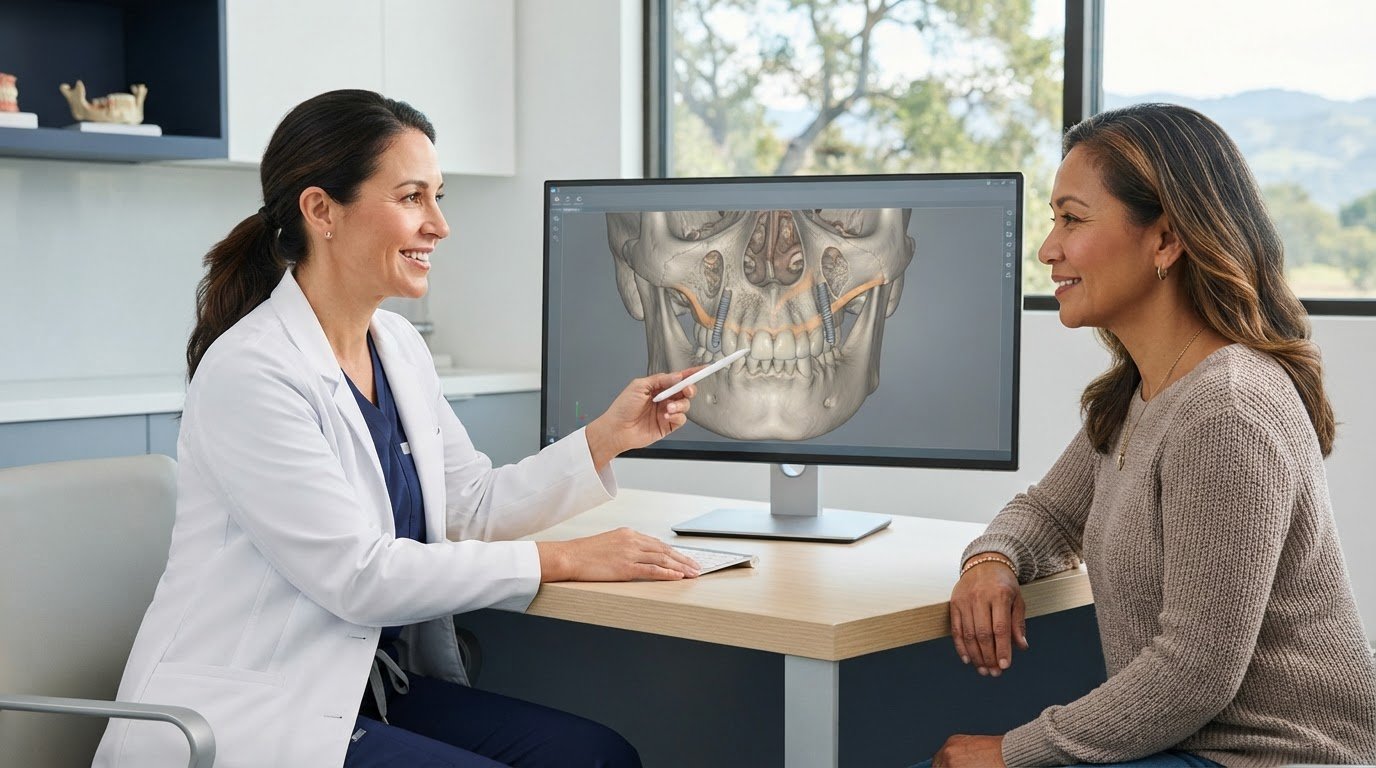

One missing tooth can affect more than the space you see in the mirror. Its position, the condition of neighboring teeth and the way you bite all influence the replacement. At Galleria OMS in Roseville, we assess the surgical side of implant care in coordination with the dentist who will make the final crown.
General education from Galleria OMS. Your examination, health history and treatment plan determine appropriate care. Follow your treating clinician’s instructions; individual results vary.
Key takeaways
- A single implant supports a crown without using adjacent teeth as bridge anchors.
- A bridge or removable replacement may still be a reasonable alternative.
- The temporary tooth and final crown are separate parts of planning.
- Immediate placement does not automatically mean an immediate final tooth.
Begin with the teeth on either side
If neighboring teeth are healthy and unrestored, preserving them may be an important reason to consider an implant. If those teeth already need crowns, a bridge may deserve a different discussion. Neither scenario establishes the answer without assessing the gap, bite and tissue health.
For a front tooth, gum contours and the visible smile line may be major concerns. A missing molar raises different questions about chewing forces and space. A treatment recommendation should explain these site-specific issues instead of treating every missing tooth identically.
| Situation or option | What it involves | What to clarify |
|---|---|---|
| Implant and crown | An implant in bone supports the replacement tooth | Is the site suitable, and who makes the crown? |
| Conventional bridge | Prepared neighboring teeth support the replacement | How healthy are those supporting teeth? |
| Resin-bonded bridge | A bonded design may suit selected sites | Does the bite and available enamel make this appropriate? |
| Removable partial or temporary tooth | An appliance fills the gap and comes out for cleaning | Is it intended as a temporary or longer-term solution? |
What a single implant actually includes
The implant is the support within the jaw. A connector, or abutment, joins it to the crown. Those parts work together, but the surgical and restorative services may be provided by different practices. Ask whether the quoted plan includes all components of the finished tooth.
Our single-tooth implant overview explains the treatment category. Your own evaluation determines implant position, preparation and sequencing.
Assess bone before choosing the schedule
Bone changes after tooth loss, but the amount and pattern vary. Examination and appropriate imaging help assess the ridge and nearby structures. A site that appears normal from above can still be narrow or have other limitations.
If grafting is recommended, ask what deficiency it addresses and whether it occurs before or with implant placement. Grafting is not required for every missing tooth, and avoiding it is not automatically the better choice.
Plan the temporary tooth before surgery
Tell the team if a visible gap is a concern. Depending on the site, a removable temporary appliance, a bonded option or a provisional crown may be discussed. Each must avoid interfering with healing. Do not assume an existing appliance can be worn over the surgical site without adjustment.
Immediate placement means placing an implant at extraction. Attaching a temporary tooth immediately is a separate decision, and the final crown is another stage. Stability, bite and tissue conditions influence what is appropriate.
Compare the full commitment
Consider visits, healing restrictions, cleaning requirements and future maintenance along with price. A replacement that looks attractive must also fit your daily routine and remain accessible for care. The implant itself does not develop a cavity, but surrounding tissues can become diseased and the crown can need repair.
Ask for a written treatment sequence and coordinated estimates. For more detail on inclusions and insurance, read our single-implant cost guide. No general online price determines your individual treatment.
Frequently asked questions
Will the implant look exactly like the lost tooth?
The restorative team plans shade, shape and tissue relationships, but an exact result cannot be promised. Discuss your appearance goals before placement.
Can I leave the gap alone?
In some situations monitoring may be reasonable. Ask about the effects on your bite, function and future replacement options rather than assuming every gap has the same consequences.
Does one missing tooth require full-arch treatment?
No. A full-arch plan addresses a different clinical situation. Decisions about remaining teeth require their own assessment.
Plan your next step with Galleria OMS
Request a consultation with our Roseville team or call 916-783-2110. Galleria Oral & Maxillofacial Surgery is located at 911 Reserve Drive, Suite 150, Roseville, CA 95678. Bring available records and your questions so we can discuss surgical options and coordination with your restorative dentist.