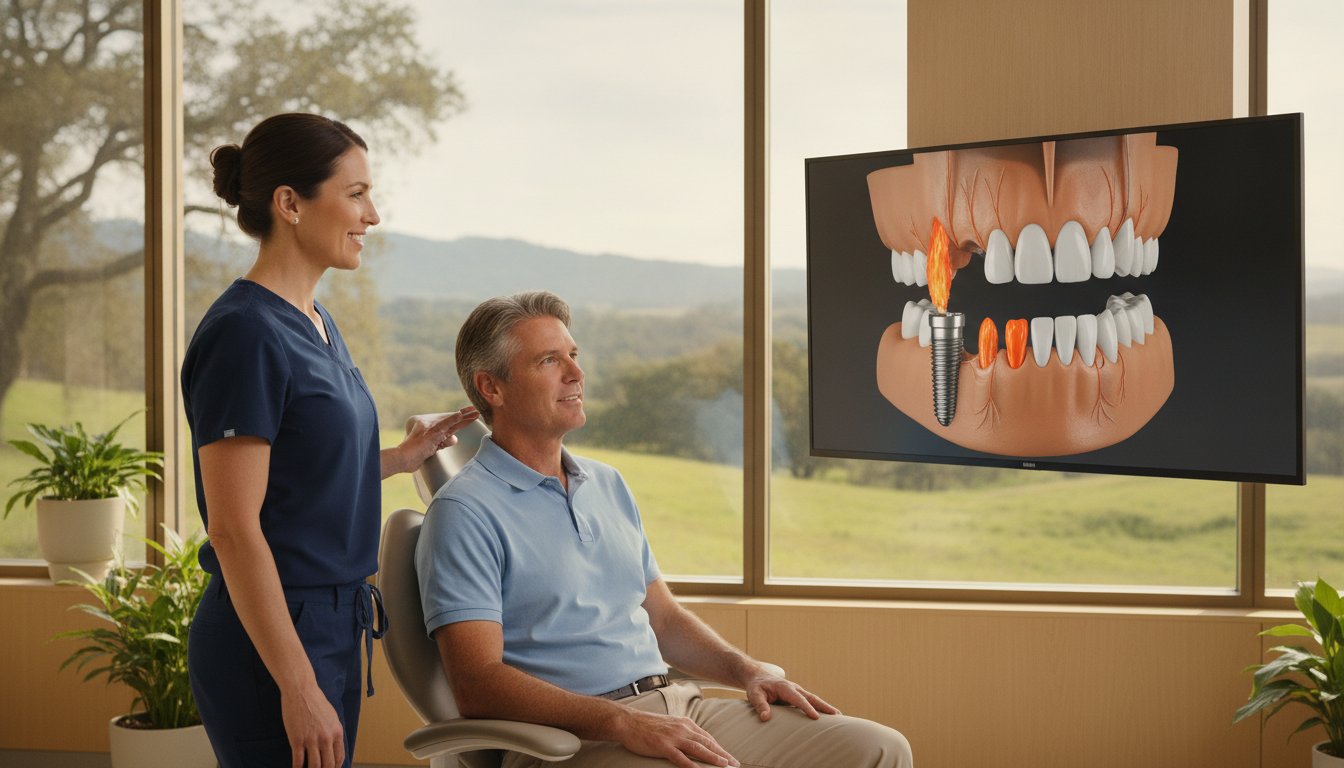

Galleria Oral & Maxillofacial Surgery in Roseville, CA evaluates and removes impacted wisdom teeth with 3D imaging and board-certified surgical care — serving Placer County and the greater Sacramento region.
Symptoms and treatment recommendations vary by individual; the information below is general education, not medical advice. Please consult a qualified oral surgeon for a personalized evaluation.
Most people get their first hint that something is wrong at the very back of the mouth — a dull ache behind the last molar, a gum flap that keeps getting sore, or a dentist who points at an X-ray and says the word "impacted."
Wisdom teeth (third molars) are the last teeth to develop, usually erupting between ages 17 and 25. By the time they arrive, the jaw is often already full. When there isn't enough room, the tooth becomes impacted — trapped under the gum, wedged against the neighboring molar, or angled sideways in the bone.
Not every wisdom tooth has to be removed. But impacted third molars rarely fix themselves, and the problems they cause tend to get more expensive to treat the longer they're left alone. Here are the signs that it's time to have them evaluated for wisdom teeth removal.
1. Pain or Pressure Behind Your Back Molars
The most common symptom of an impacted wisdom tooth is a deep, throbbing ache at the very back of the jaw. It may come and go for weeks at a time. Some patients describe it as pressure rather than pain — a feeling that their teeth are being pushed forward. That pressure is often the wisdom tooth pressing against the roots of the second molar.
2. Red, Swollen, or Tender Gums at the Back of Your Mouth
When a wisdom tooth only partially erupts, it leaves a flap of gum tissue over part of the crown. Food and bacteria collect underneath it, and the tissue becomes inflamed — a condition called pericoronitis. Signs include swelling, tenderness when you chew, and a sore spot that flares up and calms down repeatedly.
Pericoronitis is one of the most frequent reasons patients end up in an oral surgeon's chair on short notice. It responds to cleaning and antibiotics in the short term, but it usually comes back until the tooth is removed.
3. Bad Breath or a Bad Taste That Won't Go Away
A persistent foul taste or odor near the back of the mouth often means bacteria are trapped in a space you cannot reach with a toothbrush. If your breath doesn't improve after brushing, flossing, and rinsing, an impacted wisdom tooth is a common culprit.
4. Difficulty Opening Your Jaw
Swelling around a lower wisdom tooth can affect nearby muscles and make it painful to open wide — a symptom called trismus. If you're struggling to open your mouth far enough to eat comfortably, that's a sign the infection or inflammation has spread beyond the tooth itself and should be evaluated promptly.
5. Swelling in the Jaw, Cheek, or Lymph Nodes
Facial swelling, a tender lump along the jawline, or swollen glands in the neck can signal an active infection. This is not a "wait and see" symptom. An infection that started around a wisdom tooth can spread into the deeper spaces of the face and neck.
Seek same-day care if you have facial swelling with fever, difficulty swallowing, or difficulty breathing.
6. Shifting or Crowding of Your Front Teeth
Patients who spent years in braces are often the first to notice this one. While research on how much third molars contribute to crowding is mixed, many orthodontists recommend removal before or shortly after treatment to protect the result. If your lower front teeth are starting to overlap again, ask whether your wisdom teeth are a factor.
7. Cysts, Decay, or Damage Found on an X-Ray — With No Symptoms at All
This is the most important sign, because it isn't a symptom you can feel. Impacted teeth can develop dentigerous cysts — fluid-filled sacs in the bone that slowly enlarge and can damage the jaw, nerves, and neighboring roots. Impacted wisdom teeth also trap plaque against the back of the second molar, causing decay in an otherwise healthy tooth.
A panoramic X-ray or 3D cone beam CT scan shows exactly where the tooth sits, how its roots relate to the inferior alveolar nerve, and whether any of this is developing. That's why an evaluation is worthwhile even when nothing hurts.
Do All Wisdom Teeth Need to Be Removed?
No. If a wisdom tooth is fully erupted, upright, functional, and cleanable, it can often stay — with regular monitoring at your dental checkups. Removal is typically recommended when the tooth is impacted, partially erupted, decayed, causing infection, damaging the neighboring molar, or associated with a cyst.
The decision is individual, and it should be made from imaging, not guesswork. A consultation with a board-certified oral and maxillofacial surgeon gives you a clear answer either way.
Why Age Matters
Third molar roots are not fully formed until the early-to-mid twenties. Removing the teeth while the roots are still developing and the surrounding bone is less dense typically means a shorter procedure, a lower risk of nerve involvement, and a faster recovery. That's why many surgeons suggest evaluation in the mid-to-late teens even when there are no symptoms.
Removal in your thirties, forties, or later is still very much possible — it simply tends to be a more involved surgery with a longer healing period. Our wisdom teeth aftercare guide covers what recovery looks like step by step.
Frequently Asked Questions
Can an impacted wisdom tooth cause headaches or ear pain?
Yes. Pain from the lower third molar region frequently radiates to the ear, temple, and side of the head because these areas share nerve pathways with the jaw.
How long can I put off wisdom teeth removal?
If the tooth is asymptomatic and being monitored with X-rays, waiting can be reasonable. If there's active infection, decay, or a cyst, delay usually makes the procedure harder and the recovery longer.
Will my wisdom teeth eventually push through on their own?
Sometimes, but a tooth angled sideways in the bone will not straighten itself. Partial eruption often creates the gum flap that leads to repeated infections. In select cases where a tooth should be guided into place rather than removed, impacted tooth exposure is an option.
Is wisdom teeth removal painful?
The procedure itself is not — it's performed under local anesthesia, IV sedation, or general anesthesia. Most patients describe the recovery as soreness and swelling that peaks around day two or three and improves steadily from there.
Get a Clear Answer in One Visit
At Galleria Oral & Maxillofacial Surgery in Roseville, Dr. Alexander Antipov and Dr. André-David Kahwach evaluate third molars with 3D imaging and walk you through exactly what's happening at the back of your mouth — including whether removal is actually necessary.
We see patients from Roseville, Rocklin, Granite Bay, Folsom, Lincoln, El Dorado Hills, Sacramento, and throughout Northern California.
Call (916) 783-2110 or schedule a consultation online.